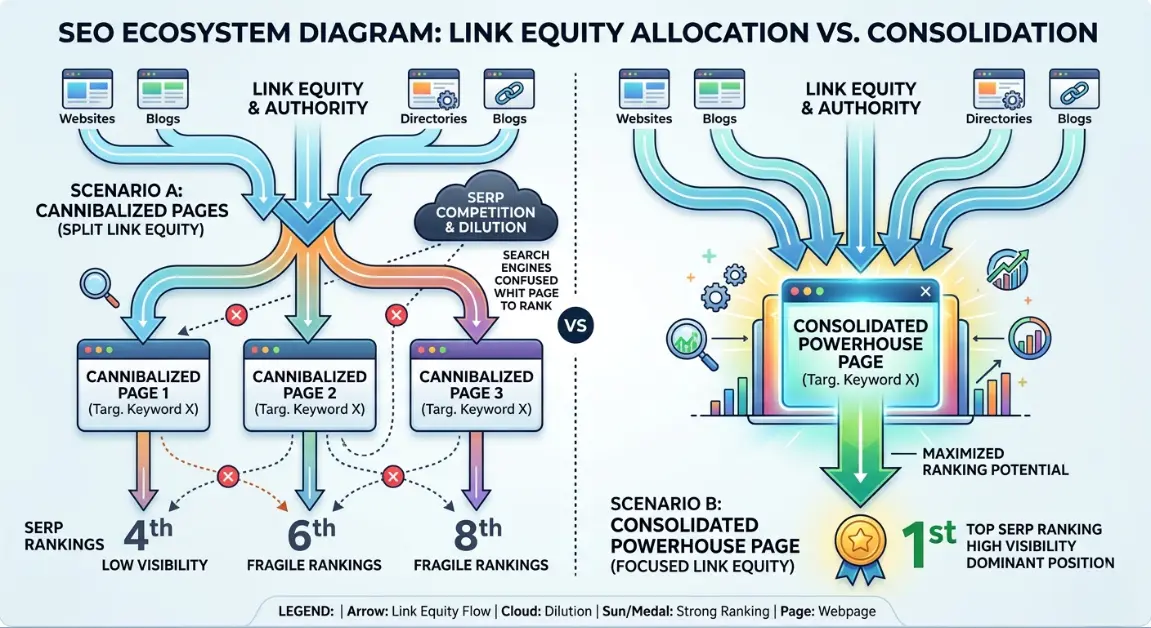
You’ve published a massive portfolio of content. You target great keywords, build solid backlinks, and publish consistently. Yet, your organic traffic is dropping. You look at the SERPs and realize Google is constantly swapping which of your URLs ranks for your target keyword. One day it’s a blog post at position #8, the next day it’s a product page at position #14.
You are bleeding traffic, and you don’t even realize you are attacking yourself.
When enterprise brands, affiliate marketers, and niche site builders ask me, What is Cannibalization in SEO How to Fix It, I give them a harsh reality check: creating more content is often your biggest enemy. In 2026, search engines punish redundancy. Google’s helpful content systems and AI search engines like ChatGPT, Gemini, and Perplexity demand clear, singular, authoritative answers. If you have five pages answering the exact same question, you don’t look like an expert you look like a spammer.
Let’s cut the generic fluff. Here is the definitive, experience-driven guide on What is Cannibalization in SEO How to Fix It, and how to consolidate your site architecture to dominate the top 3 spots.
Why This Matters for SEO Growth
➡️ Quick Answer: Keyword cannibalization occurs when multiple pages on your site compete for the same search query, confusing Google. In 2026, this results in extreme SERP volatility and ranking signals dilution. Fixing it consolidates your link equity, ensures the right page satisfies user intent, and stabilizes your organic traffic growth.
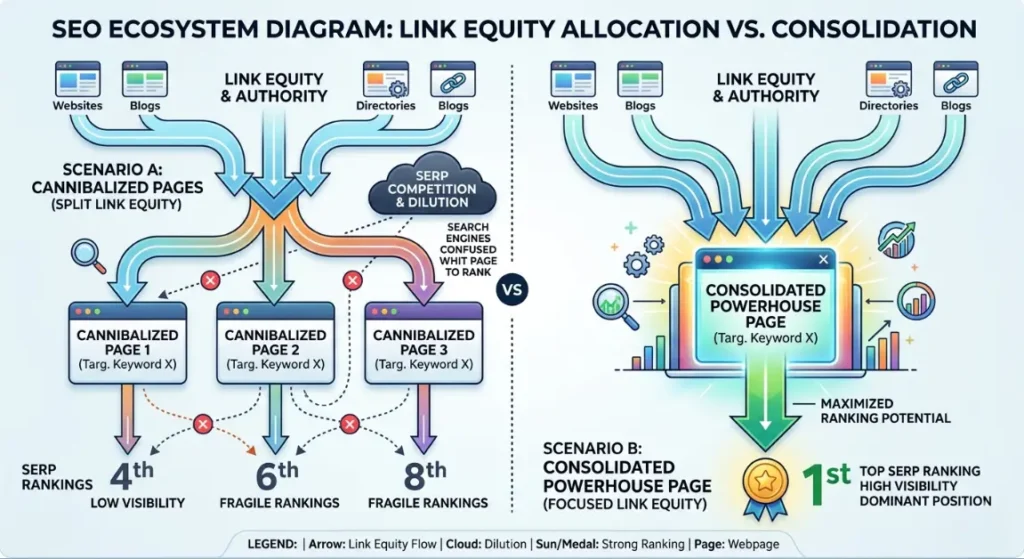
Understanding What is Cannibalization in SEO How to Fix It is critical because the algorithm has zero tolerance for ambiguity. Previously, you could rank multiple URLs on page one for the same term. Today, Google enforces strict site diversity. If you have three pages targeting “best protein powder,” Google won’t rank all three; it will get confused, dilute the authority across them, and ultimately rank your competitor’s single, comprehensive page above yours.
I recently audited a massive tech blog. They were asking, What is Cannibalization in SEO How to Fix It, after losing 40% of their traffic. They had 15 different articles on “how to build a PC.” By mapping the intent, consolidating the content, and 301 redirecting the competing URLs into one master pillar page, their traffic didn’t just recover it tripled. That is the power of stopping self-competition.
Understanding SEO Fundamentals (Through the Cannibalization Lens)
➡️ Quick Answer: Cannibalization fractures your SEO fundamentals. It splits your on-page relevance, confuses your technical architecture, and divides your off-page backlinks across multiple URLs instead of compounding them. Mastering SEO requires mapping one primary search intent to one definitive URL.
To truly grasp What is Cannibalization in SEO How to Fix It, you must look at how it destroys the four pillars of search:
- On-page SEO: If two pages have the same H1s, title tags, and keyword density, you are forcing Google to guess which page is more relevant. This leads directly to Duplicate content SEO penalties.
- Technical SEO: Crawl budget is precious. If Googlebot spends time crawling five competing pages instead of your money page, your technical architecture is failing. A clean site has no dead ends and no competing paths.
- Backlinks: This is where Ranking signals dilution kills you. Imagine acquiring 10 powerful backlinks. If 5 point to URL ‘A’ and 5 point to URL ‘B’, neither page has the strength to outrank a competitor who has 10 links pointing to a single URL.
- Search Intent: A user searching “buy running shoes” wants a category page. A user searching “how to choose running shoes” wants a blog post. If your blog post cannibalizes your product page, you lose the sale.
Advanced SEO Strategies That Actually Work
➡️ Quick Answer: Fixing cannibalization requires brutal prioritization. You must identify competing URLs via Google Search Console, merge weak content into a primary pillar page using 301 redirects, alter the search intent of overlapping pages, or use canonical tags to consolidate ranking signals without deleting pages.
Here is my exact, battle-tested framework for What is Cannibalization in SEO How to Fix It.
1. Content Consolidation (The Merger Method)
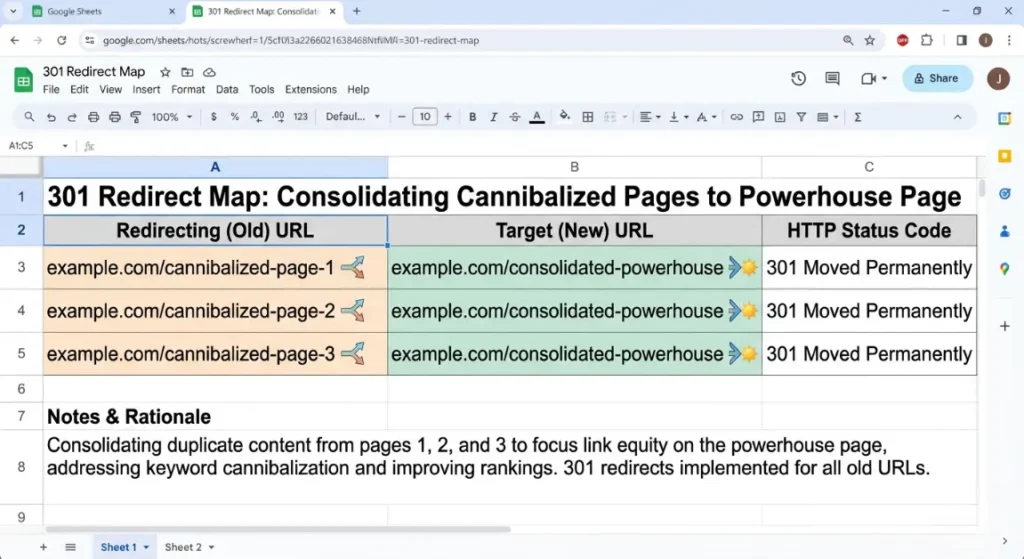
- What it is: Taking 2-4 pages that target the same intent, merging the best content into the strongest URL, and 301 redirecting the losers to the winner.
- When to use: When you have multiple blog posts covering the exact same topic with no distinct angle.
- Pros: Instantly cures Ranking signals dilution; compounds backlink power.
- Cons: You must permanently delete overlapping pages, which scares some site owners.
- Difficulty: Medium.
- Real Example: An affiliate site had four posts on “best CRM for small business.” I combined the unique insights from all four into the highest-ranking URL, then implemented server-side 301 redirects for the others. The main URL jumped from position #8 to #2 in three weeks.
2. Identifying the Culprits via Google Search Console
- What it is: Exporting query data to find multiple URLs ranking for the exact same keyword.
- When to use: Step one of any audit. If you are asking How to identify keyword cannibalization using Search Console, this is the method.
- Pros: Free, 100% accurate data straight from Google.
- Cons: Requires manual spreadsheet sorting and pivot tables for large sites.
- Difficulty: Medium.
- Real Example: In GSC, go to Performance > Search Results. Filter by a specific Query. Look at the “Pages” tab. If you see two or more URLs getting impressions for that query, and constantly swapping positions (high SERP volatility), you have confirmed cannibalization.
3. Fixing Keyword Cannibalization for E-commerce Product Pages
- What it is: Using canonical tags or merging variant pages (colors, sizes) into a single master product URL.
- When to use: When Fixing keyword cannibalization for e-commerce product pages.
- Pros: Cleans up faceted navigation; prevents duplicate content issues.
- Cons: Requires technical precision with rel=”canonical” tags.
- Difficulty: Advanced.
- Real Example: A Shopify store had separate URLs for a red shirt, blue shirt, and green shirt. All three were cannibalizing the term “mens cotton shirt.” We canonicalized the color variants to the main product page URL. Traffic consolidated, and the main page took the #1 spot.
4. De-optimization and Intent Shifting
- What it is: Changing the angle, title tag, and H1 of a cannibalizing page so it targets a completely different long-tail keyword or search intent.
- When to use: When both pages have good backlinks and traffic, so you don’t want to delete or redirect either of them.
- Pros: Saves both pages while removing the competition.
- Cons: Requires significant content rewriting.
- Difficulty: High.
- Real Example: A client had a page on “SEO Audit” (Service Page) and “SEO Audit Guide” (Blog Post). The blog post was outranking the service page for the transactional term, killing conversions. We de-optimized the blog post by changing the focus to “Free SEO Audit Checklist 2026,” shifting its intent to informational.
5. Executing an Internal Link Audit
- What it is: Crawling your site to ensure you aren’t pointing the same exact match anchor text to multiple different pages.
- When to use: When Google is confused about which page is your primary pillar.
- Pros: Sends massive, clear relevancy signals to Googlebot.
- Cons: Time-consuming on large sites.
- Difficulty: Easy but tedious.
- Real Example: Using Screaming Frog, we ran an Internal link audit. The client had 50 internal links using the anchor text “weight loss program” pointing to 5 different pages. We updated the links so 100% of that exact match anchor text pointed to the single primary sales page. Cannibalization solved.
Common SEO Mistakes to Avoid
➡️ Quick Answer: The most damaging mistakes when fixing cannibalization include 301 redirecting unrelated pages, keyword stuffing to force relevance, ignoring search intent mismatches, and having no topical authority plan. Randomly deleting pages without mapping backlinks destroys your site architecture.
When site owners try to learn What is Cannibalization in SEO How to Fix It, they often make things worse:
- Wrongful Redirection: Do not 301 redirect a page about “Apple Laptops” to a page about “Android Phones” just to consolidate. If the intent doesn’t match, Google treats it as a soft 404, and you lose all ranking power.
- Ignoring Intent: A transactional product page and an informational blog post can technically rank for the same broad keyword. Do not delete the blog post if it’s capturing top-of-funnel traffic. Shift the intent instead.
- Bad Internal Linking: Linking to your cannibalized pages using exact match anchors confuses the algorithm. Clean up your internal linking first.
- No Topical Authority Strategy: Writing 10 articles on the same topic isn’t “topical authority” it’s spam. Real authority is writing one pillar page, and 9 distinctly different supporting sub-topics.
SEO Tools Comparison Table
To effectively find and eliminate self-competition, you need the right data. Here are the tools I rely on:
| Tool | Best For | Difficulty | Cost | Rating |
| Ahrefs | Backlink checking on cannibalized URLs | Medium | High | ⭐⭐⭐⭐⭐ |
| SEMrush | Position tracking & cannibalization reports | Medium | High | ⭐⭐⭐⭐ |
| Google Search Console | Free insights & exact impression data | Easy | Free | ⭐⭐⭐⭐⭐ |
| Screaming Frog | Deep internal link auditing | Advanced | Medium | ⭐⭐⭐⭐⭐ |
Sample SEO Strategy Stacks
Stack 1: Beginner SEO Stack (Bloggers)
- Detection: Google Search Console (Performance -> Pages vs Queries).
- Action: Manual merging of overlapping blog posts.
- Redirection: Simple 301 redirect plugin (like RankMath or Redirection).
- Goal: Learn the basics of What is Cannibalization in SEO How to Fix It without spending money on premium tools.
Stack 2: Affiliate Site Stack (Niche Builders)
- Detection: Ahrefs Organic Keywords report (filtering for multiple URLs ranking for the same keyword) What is Cannibalization in SEO How to Fix It.
- Action: Content consolidation of thin review pages into massive “Best of” roundups.
- Auditing: Regular Internal link audit using Link Whisper or custom crawls.
- Goal: Trap all link equity into a few high-converting money pages.
Stack 3: Programmatic SEO Stack (Enterprise/Scale)
- Detection: SEMrush Cannibalization Health tool + custom API scripts.
- Action: Automated canonical tag injection based on database hierarchies.
- Auditing: Screaming Frog spider crawls to map dynamic faceted URLs.
- Goal: Manage millions of URLs, particularly focusing on Fixing keyword cannibalization for e-commerce product pages. What is Cannibalization in SEO How to Fix It
SEO Cost Breakdown What is Cannibalization in SEO How to Fix It
➡️ Quick Answer: Fixing keyword cannibalization is highly cost-effective because it leverages existing assets. Expect to pay $100-$300 for premium crawler tools. Hiring an SEO expert for a cannibalization audit ranges from $1,000 to $3,500. However, by consolidating content, you save thousands in wasted future backlink and content creation costs.
- Tools Cost: Screaming Frog ($259/year), Ahrefs ($129+/month).
- Backlinks Cost: If you have been buying links ($200+ per link) to cannibalized pages, you are burning money. Consolidating URLs rescues that sunk cost.
- Content Cost: Rewriting and merging content will require editorial time, costing roughly $50-$150 per consolidated pillar page if outsourced.
Related Articles
To continue dominating your technical SEO architecture, read our related guides:
- The 2026 Guide to Running a Technical Internal Link Audit
- Traditional SEO Foundation
- How to Consolidate Content Without Losing Organic Traffic
- Fixing E-Commerce SEO: Canonical Tags vs 301 Redirects
- Understanding Search Intent in the Era of AI Overviews
- How to Create SEO Friendly URL Structure 2026
- How to Optimize for Mobile-First Indexing 2026
- What is Core Web Vitals How to Improve Scores 2026
FAQs (AEO Optimized)
What is Cannibalization in SEO How to Fix It?
Keyword cannibalization happens when multiple pages on your website target the same search query, forcing them to compete against each other in Google’s index. To fix it, you must conduct an audit to identify the overlapping pages. Then, either merge the weak pages into the strongest page and set up 301 redirects, or use canonical tags to tell Google which URL is the master version.
Does keyword cannibalization hurt rankings in 2026?
Yes, Does keyword cannibalization hurt rankings in 2026 is a vital question. In modern SEO, it absolutely destroys rankings. Google’s algorithms emphasize diversity and authoritative consolidation. If you split your backlink equity and behavioral signals across five pages instead of one, you suffer from ranking signals dilution, allowing competitors with a single, consolidated page to easily outrank you.
How to identify keyword cannibalization using Search Console?
To learn How to identify keyword cannibalization using Search Console, open the Performance report and click on a specific high-value query. Then, click the “Pages” tab. If you see two or more URLs accumulating impressions and clicks for that exact query especially if their average positions fluctuate wildly day-by-day you are actively experiencing keyword cannibalization.
What is the best way of Fixing keyword cannibalization for e-commerce product pages?
When Fixing keyword cannibalization for e-commerce product pages, do not randomly delete pages, as you may lose long-tail product traffic. Instead, use rel=”canonical” tags. If you have URLs for red, blue, and green shoes, point the canonical tags of the color variants to the main master product URL. This consolidates ranking power without removing the user’s ability to browse variations.
Is it ever okay to have two pages ranking for the same keyword?
If you hold positions #1 and #2 for a keyword, do nothing. You are dominating the SERP. Cannibalization is only a problem when your URLs are suppressing each other (e.g., both are stuck on page 2, or they constantly swap between position #6 and #12, causing SERP volatility). If you own the top spots, leave the architecture alone.
Final Thoughts
Mastering What is Cannibalization in SEO How to Fix It is the fastest way to experience rapid traffic growth without publishing a single new word. By auditing your site, executing precise content consolidation, and streamlining your internal links, you stop fighting yourself and start fighting your competitors.
Stop writing the same beginner guide 15 times. Build one authoritative, unbeatable pillar page, redirect the noise, and watch your rankings soar.
Call To Action
Are you terrified that your massive content archive is actually dragging your rankings down? What is Cannibalization in SEO How to Fix It Don’t let self-competition destroy your organic traffic. Log into Google Search Console today, filter by your top keyword, and see how many URLs are fighting for the spotlight.
If you need a professional set of eyes to diagnose your site architecture, subscribe to our newsletter for weekly, no-BS technical SEO blueprints, or drop your domain in the comments below for a rapid-fire cannibalization check!
Leave a Reply