Opening: The Traffic Problem Nobody Wants to Admit
You published 40 articles. Your site is live. You have Google Analytics installed. And yet crickets.
No organic traffic. No rankings. No clicks. Just you refreshing Search Console hoping something changed overnight.
This is the most common experience for bloggers, niche site builders, and affiliate marketers who skip the most important thing: building a traditional SEO foundation that actually works.
Here’s the truth: most sites fail not because of bad content, but because they are built on sand. No keyword strategy. No technical structure. No link authority. They wrote and hoped and Google ignored them completely.
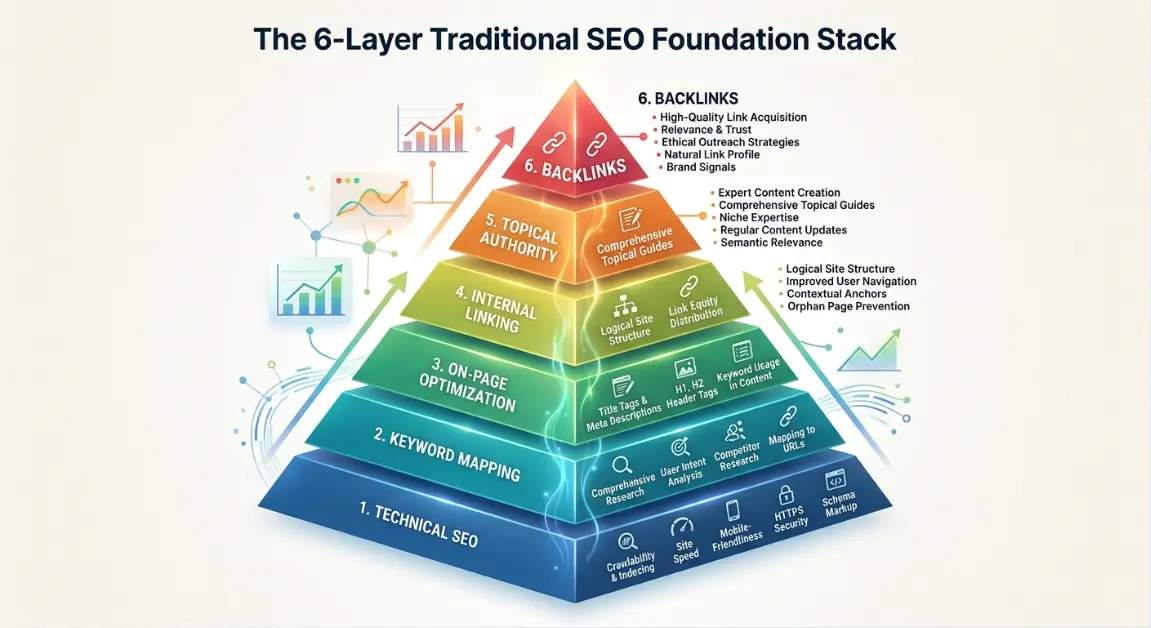
In 2026, the algorithm is smarter, AI search is reshaping discovery, and competition is fiercer than ever. But the traditional SEO foundation, the core principles that have driven rankings for years still dominates how Google decides who gets Page 1.
This guide will walk you through every layer of that foundation. From keyword research to technical audits, from backlink building to topical authority. Not theory. Real strategies that rank real sites.
Let’s build your foundation right.
Why This Matters for SEO Growth in 2026
Quick Answer (Snippet Block): The traditional SEO foundation matters because Google’s ranking system still prioritizes relevance, authority, and technical performance. Without it, no amount of content or links will consistently rank your pages. Sites with a strong SEO foundation see 3–5× more organic traffic than those relying on content alone.
The Algorithm Has Changed But the Foundation Hasn’t
Google has rolled out hundreds of updates: Helpful Content, Core Updates, E-E-A-T signals, SGE (Search Generative Experience). Each update shifts the landscape. But every single one of these updates rewards the same underlying qualities:
- Relevance Does your page answer the query better than competitors?
- Authority Does your domain earn trust from other sites?
- Experience Is your site fast, crawlable, and user-friendly?
These three pillars ARE the traditional SEO foundation. They haven’t changed since PageRank was invented. What has changed is how precisely Google can measure them.
A Real Ranking Scenario
In late 2024, a small affiliate site in the home improvement niche was stuck on Page 3 for its primary keywords. The site had 80+ articles, decent writing, and some social traffic. But no traditional SEO foundation.
After a 90-day rebuild fixing crawl errors, restructuring internal links, implementing keyword mapping, and earning 12 high-authority backlinks the site jumped to Position 4 on its core keyword (17,000 monthly searches) and landed 3 featured snippets. Traffic went from 800 to 14,000 monthly organic visits.
The content didn’t change. The foundation did.
Understanding SEO Fundamentals
Quick Answer (Snippet Block): SEO fundamentals include four core components: on-page SEO (content and HTML optimization), technical SEO (site speed, crawlability, structure), backlinks (external authority signals), and search intent alignment (matching content to user needs). Mastering all four is what defines a solid traditional SEO foundation.
On-Page SEO: Where Rankings Start
On-page SEO is everything you control directly on the page. This is the first layer of your traditional SEO foundation.
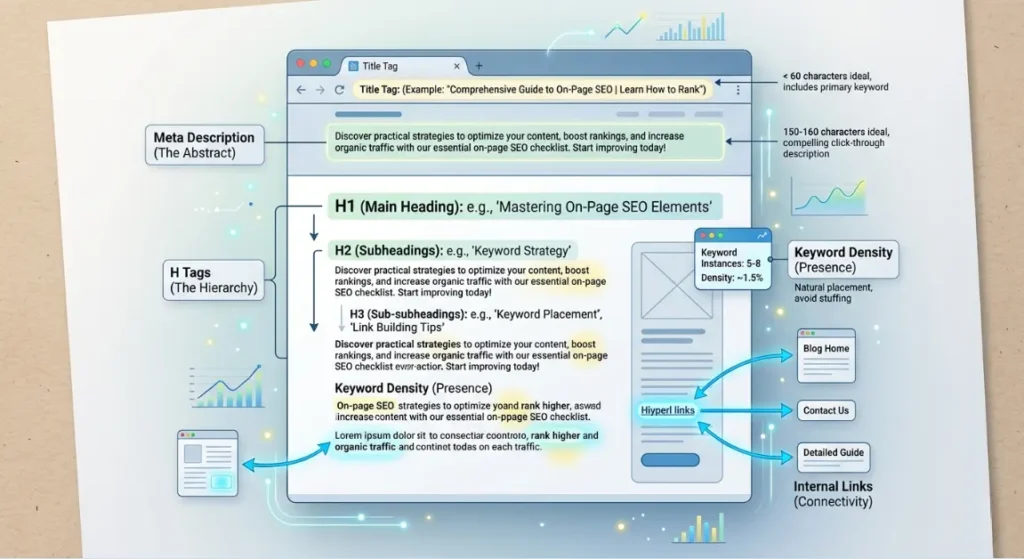
The critical on-page elements in 2026:
- Title Tag Must include your focus keyword naturally. Keep it under 60 characters. Write it for humans, not just bots.
- Meta Description Not a ranking factor, but directly impacts CTR. Make it compelling, 150–160 characters.
- H1–H6 Structure One H1 (your focus keyword included), logical H2–H3 hierarchy signaling topic coverage.
- Keyword Placement Focus keyword in the first 100 words, in at least one H2, and distributed naturally (not stuffed).
- Content Depth Google rewards comprehensive coverage. Thin content signals low value.
- Internal Links Connects your content, distributes PageRank, helps Google understand your site architecture.
- Image Alt Text Describes images for both accessibility and crawlers.
Technical SEO: The Invisible Infrastructure
Technical SEO is what happens under the hood. Even the best content fails if Google can’t properly crawl, index, and understand your site.
Key technical SEO pillars:
- Crawlability Is Googlebot able to access your pages? Use Google Search Console’s URL Inspection tool to check.
- Indexation Are your pages actually in Google’s index? A site with 100 pages but only 30 indexed has a serious technical problem.
- Core Web Vitals LCP (load speed), CLS (layout stability), INP (interactivity). These are confirmed ranking signals.
- Mobile-First Google indexes the mobile version of your site. A bad mobile experience hurts rankings.
- HTTPS A baseline trust signal. Non-HTTPS sites struggle for rankings in 2026.
- XML Sitemap + Robots.txt Your roadmap for crawlers. Misconfigured files can accidentally block entire sections of your site.
- Structured Data (Schema) Tells Google what your content means, not just what it says. Critical for featured snippets and AI-powered search.
Tools like Screaming Frog, Google Search Console, and Ahrefs Site Audit are your best allies for identifying technical issues that silently kill your rankings.
Backlinks: The Authority Signal Google Still Trusts Most
Despite all the algorithm changes, backlinks remain the most powerful off-page ranking signal. A traditional SEO foundation without a backlink strategy is like building a house without a roof.
What makes a backlink valuable:
- Domain Authority A link from Forbes beats 100 links from unknown blogs.
- Relevance A backlink from a fitness site to your fitness article carries far more weight than one from a cooking blog.
- Anchor Text The clickable text of a backlink sends topical signals to Google.
- Dofollow vs. Nofollow Dofollow links pass link equity; nofollow links are less impactful but still have value.
Search Intent: The Most Underused Element of SEO
Search intent is why someone is searching, not just what they’re searching. Misaligning your content with intent is the fastest way to kill your click-through rate and bounce rate simultaneously.
The four intent types:
| Intent | Example Query | Content Type |
| Informational | “what is keyword mapping” | Blog post, guide |
| Navigational | “Ahrefs login” | Homepage, tool page |
| Commercial | “best SEO tools 2026” | Comparison/review |
| Transactional | “buy Ahrefs subscription” | Product/landing page |
A page written as an informational guide will never rank for a transactional keyword and vice versa. Match intent first. Then optimize everything else.
Advanced SEO Strategies That Actually Work
Quick Answer (Snippet Block): Advanced SEO strategies go beyond basic optimization to include topical authority building, programmatic content, internal link architecture, featured snippet targeting, and entity optimization. These are the strategies that move sites from Page 2 to Page 1 and keep them there through algorithm updates.
Topical Authority The 2026 Ranking Superpower
What it is: Topical authority means Google recognizes your site as a comprehensive, trustworthy resource on a specific subject. Instead of ranking for one or two keywords, you rank for hundreds across an entire topic cluster.
When to use: Essential for niche sites, affiliate sites, and small business blogs competing against larger domains.
How it works:
- Choose a core topic (e.g., “home solar panels”)
- Build a pillar page covering the broad topic comprehensively
- Create cluster content covering every subtopic (installation, cost, brands, maintenance, incentives, etc.)
- Internally link all cluster pages back to the pillar
Pros: Compounding rankings over time. Protects against algorithm updates. Makes your site AI-search-friendly.
Cons: Takes 3–6 months to see results. Requires consistent content production.
Difficulty: Medium
Real Example: A personal finance site focused entirely on “debt management” pillar page + 35 cluster articles went from DA 12 and zero Page 1 rankings to 47 first-page positions in 8 months. The same traffic would have cost $34,000/month in Google Ads.
Featured Snippet Targeting (AEO)
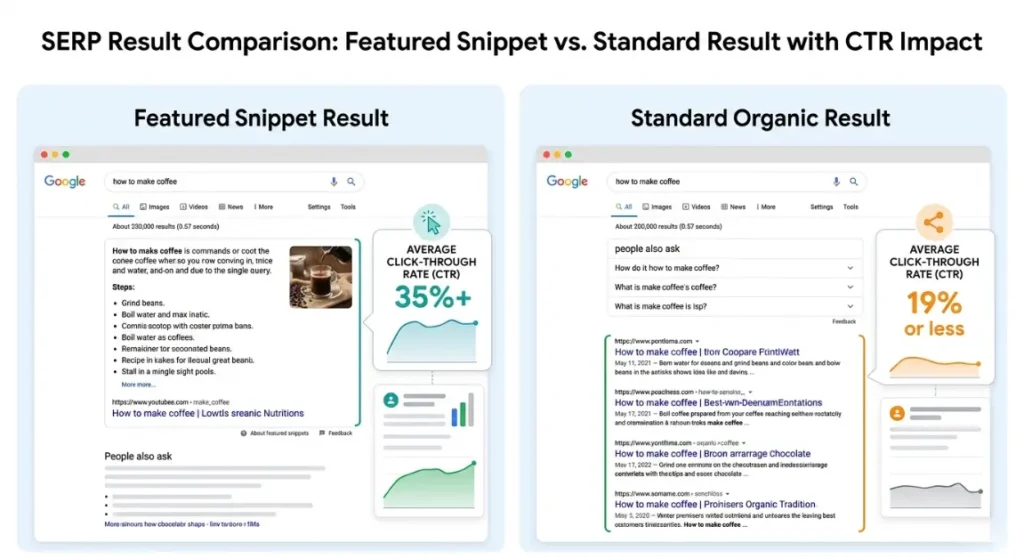
What it is: Featured snippets are the answer boxes that appear above regular results (Position 0). Capturing them requires structuring your content specifically for direct answers.
When to use: For any informational query with a clear, concise answer definitions, how-tos, lists, tables.
How it works:
- Identify queries that already have a snippet (use SEMrush’s “SERP Features” filter)
- Format your answer in 40–60 words directly below the relevant H2
- Use the exact question as a subheading when possible
- For list snippets: use numbered or bulleted lists
- For table snippets: use properly formatted HTML tables
Pros: Position 0 gets clicks even when you’re not #1. Builds massive brand visibility.
Cons: Snippet can display your answer without a click (zero-click risk). But brand exposure still drives traffic long-term.
Difficulty: Medium
Real Example: A how-to cooking blog rewrote 12 articles with proper snippet blocks and captured 7 featured snippets within 6 weeks, increasing CTR on those pages by an average of 43%.
Internal Link Architecture
What it is: A deliberate system of internal links that distributes PageRank across your site, signals content hierarchy to Google, and guides users deeper into your content.
When to use: From day one of publishing. Retrofitting internal links to existing content is also highly effective.
The hub-and-spoke model:
- Hub = pillar page (receives and distributes the most links)
- Spokes = cluster articles (link to the hub AND to related spokes)
Best practices:
- Use descriptive anchor text (not “click here”)
- Link from high-traffic pages to new or underperforming pages
- Keep key pages within 3 clicks of your homepage
- Use Screaming Frog or Ahrefs to audit orphaned pages (pages with zero internal links)
Difficulty: Easy to implement, medium to master
Real Example: An affiliate site discovered 31 orphaned pages through a Screaming Frog crawl. After adding 2–3 internal links to each, 14 of those pages moved from unranked to Page 1–2 within 10 weeks.
E-E-A-T Signals (Experience, Expertise, Authoritativeness, Trustworthiness)
What it is: Google’s quality framework for evaluating content credibility. Not a direct ranking factor, but a lens through which quality raters and algorithm signals are applied.
When to use: Critical for YMYL (Your Money or Your Life) niches health, finance, legal, safety. Increasingly important everywhere else in 2026.
How to implement:
- Add author bios with real credentials and social proof
- Cite credible sources (link out to authoritative domains)
- Use first-person experience where applicable (“In my testing of Ahrefs vs SEMrush…”)
- Display business information, contact pages, and privacy policies
- Earn editorial mentions and backlinks from industry publications
Difficulty: Medium-High
Keyword Mapping and Cannibalization Prevention
What it is: Keyword mapping assigns specific target keywords to specific pages and prevents two pages from competing against each other for the same query (cannibalization).
When to use: Before publishing new content AND as a site audit step for existing sites.
Step-by-step process:
- Export all your published URLs
- Run a site: search or use Google Search Console to see which keywords each page ranks for
- Identify overlapping rankings (two pages competing for the same keyword)
- Resolve by consolidating content, 301 redirecting, or rewriting one page’s focus
Tools: Google Search Console (free), Ahrefs, SEMrush
Difficulty: Medium
Real Example: A niche site had 4 articles all targeting variations of “best protein powder for women.” After consolidating into one comprehensive guide and 301-redirecting the others, the single page climbed from Position 18 to Position 5 in 45 days.
Programmatic SEO
What it is: Creating hundreds or thousands of pages automatically by combining templates with structured data targeting long-tail keyword clusters at scale.
When to use: For sites with access to large datasets location-based businesses, SaaS tools, travel, real estate, job boards.
How it works:
- Identify a repeatable keyword pattern (e.g., “best in [city]”)
- Build a database of unique variables
- Create a template that auto-populates with unique, useful content
- Publish at scale with proper canonical and indexing controls
Pros: Massive keyword coverage. Compounding traffic. Scalable growth engine.
Cons: Risk of thin content if not done properly. Requires technical setup. Can trigger Google spam filters.
Difficulty: High
Real Example: Zapier built 25,000+ programmatic pages targeting “how to connect [App A] with [App B].” This single strategy drives millions in monthly organic traffic.
Content Refresh Strategy
What it is: Systematically updating existing articles to improve rankings, freshness signals, and featured snippet eligibility.
When to use: Any page that has dropped in rankings or hasn’t been updated in 12+ months.
What to update:
- Statistics and data (link to current sources)
- Outdated tool recommendations
- SERP-driven additions (add sections that competitors rank for)
- Snippet blocks (ensure direct answer formats)
- Internal links to newer content
Difficulty: Easy
Real Example: A site refreshed its top 15 articles updating stats, adding 300–500 words each, and adding snippet blocks. Average ranking improvement: +6 positions. Some moved from Page 2 to Page 1 within 3 weeks of Google recrawling.
Common SEO Mistakes to Avoid
Quick Answer (Snippet Block): The most damaging SEO mistakes include keyword stuffing, ignoring search intent, building an orphaned content structure, neglecting technical SEO basics, and trying to rank without a clear topical focus. Each of these can stall your rankings for months or trigger a Google penalty.
1. Keyword Stuffing Repeating your focus keyword 50 times in 1,000 words doesn’t help it triggers spam filters and reads unnaturally. Target 1–2% keyword density. Use semantic variations (LSI keywords) instead.
2. Ignoring Search Intent Writing a “what is” article for a keyword where users want a comparison will get you ranked, briefly, before Google pushes you back down when the bounce rate signals mismatch. Always check the top 5 results for your keyword before deciding content format.
3. Zero Internal Linking Orphaned pages articles with no internal links pointing to them are essentially invisible to Google. Every new article you publish should receive at least 2–3 internal links from existing pages.
4. No Topical Authority Strategy Publishing 3 articles on fitness, 5 on finance, and 2 on travel tells Google your site has no clear focus. Pick a niche. Build depth. Topical authority is what separates sites that grow from sites that plateau.
5. Neglecting Core Web Vitals A site loading in 6+ seconds will struggle to hold rankings in 2026. Use Google’s PageSpeed Insights or Screaming Frog to identify speed bottlenecks. Compress images, defer JavaScript, use a CDN.
6. Buying Cheap Backlinks A dozen links from Fiverr spam networks can do more damage than having no backlinks at all. Google’s spam detection in 2026 is sophisticated. Earned links and digital PR are the only sustainable approach.
7. Duplicate Content Two pages targeting the same keyword = keyword cannibalization. Use canonical tags, consolidate content, or differentiate clearly.
SEO Tools Comparison Table
| Tool | Best For | Difficulty | Cost | Rating |
| Ahrefs | Keyword research, backlink analysis | Medium | High ($129+/mo) | ⭐⭐⭐⭐⭐ |
| SEMrush | All-in-one SEO, competitor research | Medium | High ($139+/mo) | ⭐⭐⭐⭐ |
| Google Search Console | Indexing, performance data, free insights | Easy | Free | ⭐⭐⭐⭐⭐ |
| Screaming Frog | Technical SEO audits, crawl analysis | Medium | Low ($259/yr) | ⭐⭐⭐⭐⭐ |
| Surfer SEO | On-page content optimization | Easy | Medium ($89+/mo) | ⭐⭐⭐⭐ |
| Google Analytics 4 | Traffic behavior, conversion tracking | Medium | Free | ⭐⭐⭐⭐ |
| Ubersuggest | Budget keyword research | Easy | Low ($29/mo) | ⭐⭐⭐ |
Recommendation by stage:
- Beginners: Google Search Console + Ubersuggest (free-to-low cost)
- Intermediate: Add Screaming Frog + Surfer SEO
- Advanced: Ahrefs or SEMrush as the primary platform
Sample SEO Strategy Stacks
Stack 1: Beginner SEO Stack (Budget: $0–$50/month)
Perfect for new bloggers and hobby sites just establishing a traditional SEO foundation.
- Google Search Console Monitor indexing and keyword performance
- Google Analytics 4 Track behavior and conversions
- Ubersuggest Free keyword research for content planning
- Yoast SEO or RankMath WordPress on-page optimization
- Manual internal linking Map your site structure in a spreadsheet
Focus: Write 2 articles/week targeting low-competition, long-tail keywords. Build topical depth before pursuing backlinks.
Stack 2: Affiliate Site Stack (Budget: $150–$300/month)
For niche site builders and affiliate marketers who need a competitive edge.
- Ahrefs Keyword research, competitor gap analysis, backlink tracking
- Surfer SEO On-page content scoring and optimization
- Screaming Frog Monthly technical audits
- Google Search Console Performance monitoring
- Link building: HARO (free) + targeted blogger outreach
Focus: Topical authority in one niche. Publish pillar pages + 30–50 cluster articles. Target featured snippets. Build 5–10 editorial backlinks per month.
Stack 3: Programmatic SEO Stack (Budget: $300–$600/month)
For tech-forward publishers or SaaS companies targeting scale.
- Ahrefs Keyword pattern research (find repeatable templates)
- SEMrush Content gap analysis at scale
- Screaming Frog Crawl monitoring across thousands of pages
- Custom CMS or Webflow For template-based page generation
- Google Search Console API Automated performance monitoring
Focus: Identify 3–5 repeatable keyword patterns. Build data-backed templates. Publish 500–5,000 programmatic pages. Monitor indexation rates closely in GSC.
SEO Cost Breakdown
Quick Answer (Snippet Block): SEO costs in 2026 range from $0 (DIY with free tools) to $5,000+/month (full agency management). The main cost categories are tools ($0–$600/month), content creation ($200–$2,000/month), and link building ($300–$5,000/month). Most small sites can see real results with $200–$500/month invested strategically.
| Category | DIY Budget | Mid-Range | Agency-Level |
| SEO Tools | $0–$50/mo | $150–$300/mo | $400–$600/mo |
| Content Creation | $0 (self) | $500–$1,500/mo | $2,000–$5,000/mo |
| Link Building | $0 (outreach) | $300–$800/mo | $1,500–$5,000/mo |
| Technical SEO | $0–$50/mo | $100–$300/mo | $500–$2,000/mo |
| Total | $0–$100/mo | $1,000–$2,900/mo | $4,400–$12,600/mo |
The honest breakdown:
- Most niche sites at the start don’t need to spend more than $150–$300/month on tools
- The highest ROI investment at any budget is content and internal linking
- Backlinks become critical once you’ve hit a topical authority ceiling usually around 40–60 articles in a niche
What Most SEO Experts Get Wrong
Myth 1: “More Content = More Traffic”
Reality: Publishing 200 mediocre articles will not outrank 30 well-optimized, intent-matched, interlinked ones. Google in 2026 rewards depth and quality over volume. Sites that publish relentlessly without a topical strategy just dilute their own authority.
Myth 2: “Backlinks Don’t Matter Anymore”
Reality: Backlinks remain the #1 off-page ranking factor. What’s changed is quality requirements. Ten editorial links from relevant, authoritative domains will always beat 500 spam links. Anyone telling you backlinks are dead is either confused or selling something.
Myth 3: “SEO Takes 12 Months to Work”
Reality: Technical fixes can improve rankings in weeks. Internal linking improvements often show results in 30–45 days. Featured snippet targeting can pay off in under 30 days. The 12-month timeline applies to building domain authority from scratch individual optimizations work much faster.
Myth 4: “AI Will Replace Traditional SEO”
Reality: AI search (ChatGPT, Gemini, Perplexity) adds a layer it doesn’t replace Google. In fact, AEO (Answer Engine Optimization) and GEO (Generative Engine Optimization) both rely heavily on the same traditional SEO foundation: structured content, E-E-A-T signals, schema markup, and authoritative backlinks. The better your traditional SEO foundation, the better your AI search visibility.
Myth 5: “Technical SEO Is Only for Developers”
Reality: 80% of technical SEO is accessible to non-developers. Using Screaming Frog to find crawl errors, submitting sitemaps in Google Search Console, compressing images, fixing broken internal links none of this requires code. Start with the fundamentals before worrying about advanced schema or JavaScript rendering.
CTR Optimization: 3 Title Variations + 2 Meta Descriptions
Title Tag Variations
Option A (Curiosity + Keyword): Traditional SEO Foundation: What Actually Works in 2026
Option B (Number + Year): 7 Pillars of Traditional SEO Foundation Every Site Needs in 2026
Option C (Problem + Solution): Why Your Site Isn’t Ranking: Fix Your Traditional SEO Foundation
Meta Description Variations
Option A: Your traffic problems aren’t a content problem they’re a foundation problem. Learn how to build a traditional SEO foundation that ranks in 2026, with real examples, tools, and strategies.
Option B: Master traditional SEO foundation with our 2026 guide: keyword strategy, technical SEO, backlinks, and topical authority. Step-by-step tactics for bloggers & affiliate marketers.
Internal Linking Strategy
Suggested anchor texts for linking TO this article from related content:
- “traditional SEO foundation” use from any introductory SEO overview article
- “how to build an SEO strategy from scratch” use from beginner-level SEO posts
- “on-page and technical SEO basics” use from keyword research or content strategy articles
- “SEO fundamentals guide” use from niche site building or blogging income posts
- “backlink and keyword strategy” use from link building or traffic generation articles
Related Articles
- How to Conduct a Site Audit for Beginners If you want to find and fix the technical issues hurting your rankings today
- Step-by-Step Guide to Keyword Mapping Learn how to organize your keyword targets before you publish another word
- Best SEO Practices for Small Business Websites Applying traditional SEO foundation principles in a local or service business context
- On-Page SEO Checklist: 20 Elements to Optimize Before You Publish The tactical companion to this strategy guide
- How to Build Topical Authority in Any Niche The long-form guide to becoming the go-to resource Google trusts
- Complete AI Implementation Guide
FAQs (AEO Optimized)
Q1: What is a traditional SEO foundation and why does it matter?
A traditional SEO foundation refers to the core set of SEO practices that enable a website to rank on Google: keyword research, on-page optimization, technical SEO, backlinks, and search intent alignment. It matters because no algorithm update, AI tool, or content strategy can compensate for a site that lacks this fundamental infrastructure. Think of it as the structural frame of a building without it, everything else collapses.
Q2: How long does it take to see results from building an SEO foundation?
Results depend on which element you’re working on. Technical fixes (crawl errors, broken links, page speed) can show ranking improvements within 2–4 weeks. Internal linking improvements often take 30–60 days to reflect in rankings. Building topical authority through content takes 3–6 months. Domain authority gains from backlinks operate on a 3–12 month horizon. Start with technical fixes for the fastest wins.
Q3: What’s the difference between on-page SEO and technical SEO?
On-page SEO refers to the content and HTML elements on each page title tags, headings, keyword placement, internal links, and content quality. Technical SEO refers to the backend infrastructure of the site crawlability, indexation, Core Web Vitals, site speed, mobile optimization, and structured data. Both are part of the traditional SEO foundation, and neglecting either will limit your rankings regardless of how strong the other is.
Q4: Do I need expensive tools to build an SEO foundation?
No. You can build a solid traditional SEO foundation using only free tools. Google Search Console shows you which keywords your pages rank for, which pages have indexing errors, and how your site performs in search. Google Analytics 4 tracks user behavior and conversions. Google’s PageSpeed Insights identifies speed problems. Paid tools like Ahrefs and SEMrush become important when you need competitive intelligence, deep keyword research, and backlink monitoring at scale.
Q5: How does traditional SEO relate to AI search visibility in 2026?
Traditional SEO foundation is the prerequisite for AI search visibility. Tools like ChatGPT, Gemini, and Perplexity pull citations from authoritative, well-structured web sources. Sites with strong E-E-A-T signals, schema markup, clearly structured content, and editorial backlinks are far more likely to be referenced in AI-generated answers. In other words: GEO (Generative Engine Optimization) rewards the same site qualities that traditional SEO has always rewarded. Build the foundation first; AI visibility follows.
Final Thoughts: Build the Foundation Before You Build Anything Else
The sites that dominate Google in 2026 didn’t get there by hacking the algorithm or discovering secret tactics. They got there by building a traditional SEO foundation that was technically sound, content-rich, and strategically linked and they stayed there by continuing to reinforce that foundation with every new piece of content, every backlink earned, and every technical improvement made.
Here’s the practical takeaway:
Start with what you can control:
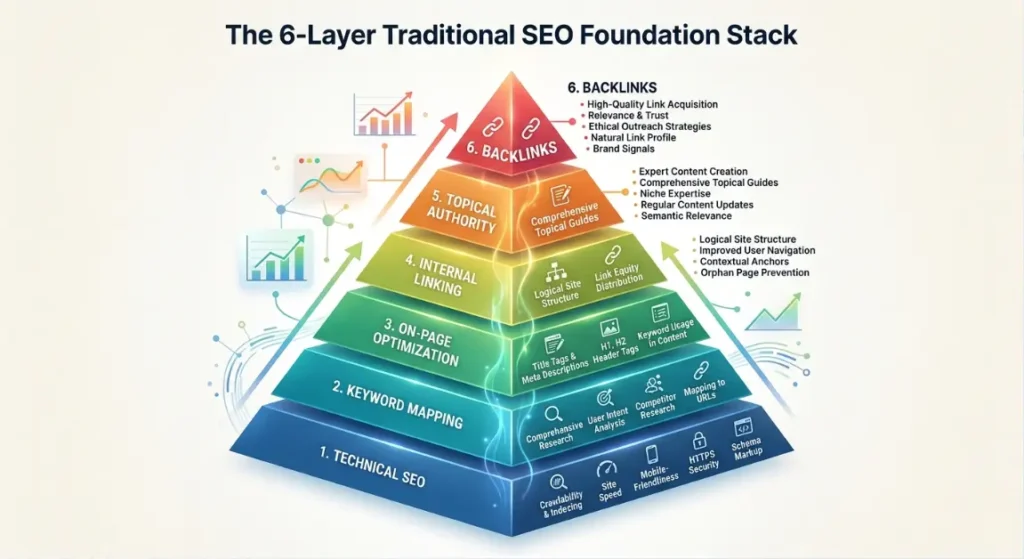
- Fix your technical SEO crawl errors, speed issues, mobile optimization
- Map your keywords know exactly what each page is targeting and why
- Build topical depth cover your niche comprehensively before going wide
- Add snippet blocks to every key article target Position 0 from day one
- Build internal links deliberately no orphaned pages, ever
- Earn backlinks through content worth linking to digital PR, HARO, original research
The traditional SEO foundation is not glamorous. It’s not a viral growth hack. But it’s the reason some sites compound traffic year after year while others stay invisible despite publishing daily.
Build it right. Build it once. Then build on top of it.
Call to Action
Ready to build your traditional SEO foundation the right way?
Start with a free technical audit using Google Search Console. Look for crawl errors, mobile usability issues, and pages with no impressions. Those are your first wins.
Then download our SEO Site Audit Checklist and work through each layer of the foundation systematically. The sites that rank aren’t the ones with the most content they’re the ones that got the fundamentals right first.
If you found this guide useful:
Leave a comment: which part of your traditional SEO foundation needs the most work?
Bookmark it for reference during your next site audit
Share it with a blogger or niche site builder who’s stuck on Page 2
Leave a Reply