Grab a cup of coffee, pull up a chair, and let’s talk about the biggest dilemma you are probably facing right now. Almost every week, a passionate founder or a small business owner sits across from my desk or on a Zoom call and asks me the exact same question: MVP vs Full Product: What to Build First in 2026?
It is a completely natural place to be stuck. You have a brilliant idea for a web application. You can see the final, polished version in your head, complete with all the bells, whistles, push notifications, and AI integrations. But you are also looking at your bank account, worrying about development costs, hiring the right developers, and picking the right frameworks without getting ripped off.
In this guide, I am going to take off my “corporate architect” hat and talk to you developer-to-founder. We are going to break down MVP vs Full Product: What to Build First in 2026 in plain English. We will look at real-world costs, the best technologies available this year, how to avoid expensive mistakes, and how to successfully launch your idea without betting your entire life savings on a wild guess. Let’s dive in.
Why This Matters for Small Businesses
Understanding MVP vs Full Product: What to Build First in 2026 is not just a technical debate; it is a critical business survival skill. An MVP (Minimum Viable Product) is the simplest, most stripped-down version of your app that actually works and solves a problem. A full product is the polished, feature-rich version you dream about.
Why does knowing the difference matter so much? Let me share a real story from a project I consulted on. A local restaurant owner wanted to build a custom food ordering and delivery app to bypass the massive fees charged by third-party delivery giants. Instead of building a simple MVP to see if his loyal customers would actually download and use his app, he insisted on building the full product right away. He paid a local agency $45,000 for complex features like real-time GPS driver tracking, a loyalty points system, and an AI-driven recommendation engine.
When it launched, crickets. His customers preferred calling in or using the third-party apps they already had installed. He burned his budget because he ignored a proper Product-market fit strategy 2026.
If he had focused on MVP vs Full Product: What to Build First in 2026, he could have spent $3,000 on a simple mobile-friendly web form and an SMS alert system. That simple MVP would have tested the waters. Small businesses cannot afford to guess what customers want. Building an MVP first protects your capital, gets you to market faster, and allows you to build your ultimate vision based on real data, not assumptions. A strong Product-market fit strategy 2026 relies heavily on launching small, learning fast, and adapting. Mastering Product-market fit strategy 2026 is how today’s top startups survive their first critical year.
Understanding the Basics
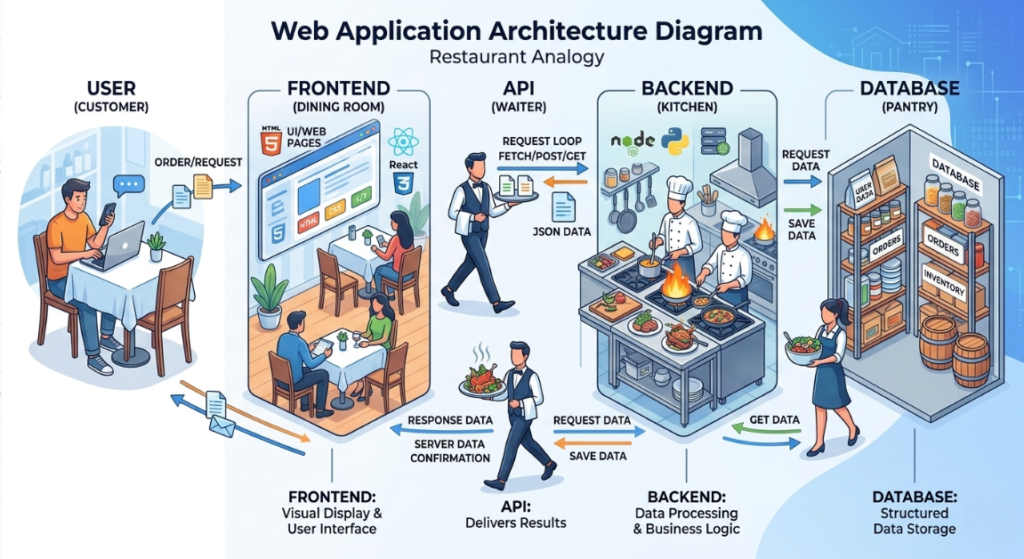
Before you can confidently answer the question of MVP vs Full Product: What to Build First in 2026, we need to speak the same language. Do not worry; I am not going to bore you with textbook definitions. Let’s use a restaurant analogy.
Think of your web application like opening a brand-new restaurant.
The Frontend: This is the dining area, the menus, the decor, and the tables. In web development, the frontend is everything your user sees and interacts with on their screen (buttons, forms, images). If it looks good and is easy to navigate, customers are happy.
The Backend: This is your kitchen. Customers do not see it, but it is where all the heavy lifting happens. The backend processes the data, handles the business logic, and makes sure the right meal (or information) gets to the right table.
The Database: This is your pantry. It is where you safely store all your ingredients (user data, passwords, product inventory, order history).
APIs (Application Programming Interfaces): Think of APIs as the waiters. They take the customer’s order from the frontend dining room, carry it to the backend kitchen, and bring the finished food back to the customer.
Hosting: This is your building lease. It is where your app physically lives on the internet (like AWS, Google Cloud, or Vercel).
When deciding on MVP vs Full Product: What to Build First in 2026, an MVP might be a simple food truck (basic frontend, simple kitchen, limited pantry). A full product is the massive flagship downtown restaurant. You want to prove your recipes sell at the food truck before signing a 10-year lease on the building.
Key Options / Technologies Explained
To make the right choice regarding MVP vs Full Product: What to Build First in 2026, you need to know the tools at your disposal. The web development landscape has shifted massively. Here are the core approaches and technologies you should consider.
No-Code Builders (e.g., Bubble, Webflow)
Overview
No-code platforms allow you to build fully functional web applications by dragging and dropping elements on a screen, without writing a single line of traditional code. They have powerful visual databases and logic workflows built right in.
Best For
Founders who have zero coding experience and want to test a concept immediately. This is the ultimate tool for Rapid prototyping for startups.
Pros: MVP vs Full Product: What to Build First in 2026
- Incredibly fast time-to-market.
- Drastically lowers initial development costs.
- Easy to make visual changes on the fly.
Cons: MVP vs Full Product: What to Build First in 2026
- You don’t truly “own” the source code; you are locked into their platform.
- Can become expensive as your user base grows.
- Not ideal for highly complex, data-heavy algorithms.
Estimated Cost
$29 – $150 / month
Learning Curve
Moderate
Real-World Use Case
A local cleaning service owner wants a portal where clients can log in, book times, and pay. Instead of paying $15,000 for a custom app, they use Bubble to build it in two weeks, leveraging Rapid prototyping for startups to launch fast. This is the essence of Rapid prototyping for startups.
AI-Assisted Prototyping (e.g., v0 by Vercel, Bolt.new)
Overview
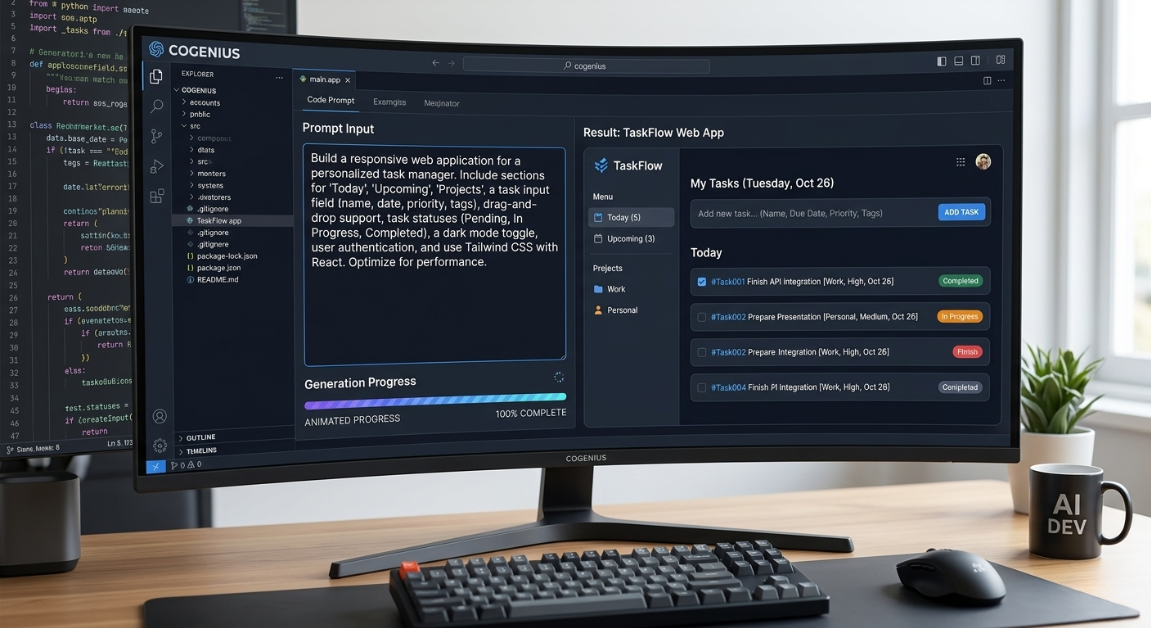
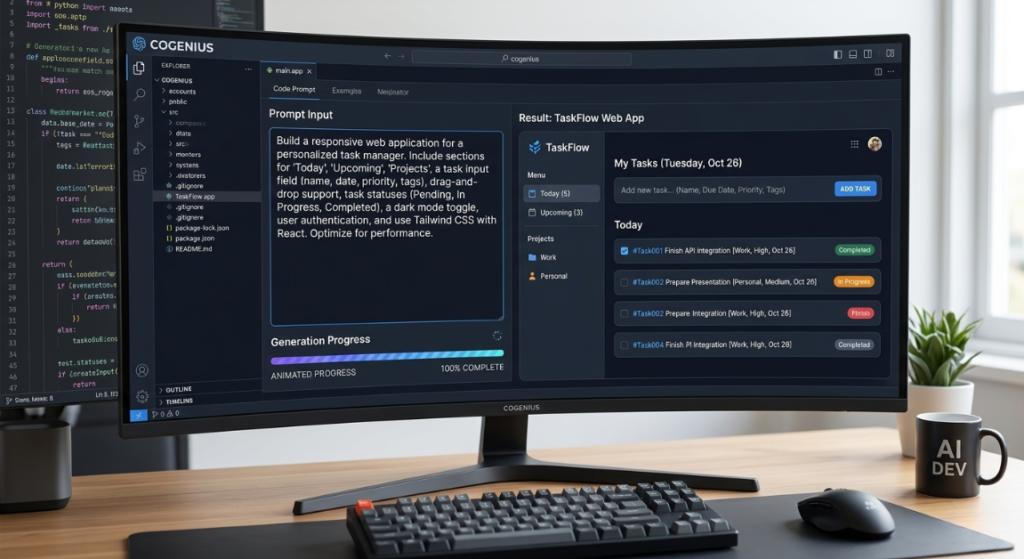
Welcome to the future. These are AI tools where you type what you want in plain English (e.g., “Build me a dashboard for a real estate business with a sidebar and a chart”), and the AI instantly generates the functional code and UI components.
Best For
Solo founders and small teams looking for the Best AI tools for building a low-cost MVP for small business.
Pros: MVP vs Full Product: What to Build First in 2026
- Feels like magic; generates code in seconds.
- Excellent for brainstorming and visualizing ideas.
- Output is usually standard React code that a developer can actually use later.
Cons: MVP vs Full Product: What to Build First in 2026
- Still requires a developer to wire up the complex backend logic.
- Can sometimes hallucinate or break if you ask for too much at once.
- It is a starting point, not a finished production app.
Estimated Cost
$20 – $50 / month
Learning Curve
Beginner
Real-World Use Case
A founder uses v0 to generate all the screens for their new SaaS app. They take these generated screens to a freelance developer, significantly cutting down design and frontend coding time. This makes them some of the Best AI tools for building a low-cost MVP for small business available today.
Backend-as-a-Service (e.g., Supabase, Firebase)
Overview
Instead of building a “kitchen” (backend) from scratch, Backend-as-a-Service (BaaS) gives you a pre-built kitchen with all the appliances. It handles your database, user authentication (logins), and file storage out of the box.
Best For
Projects that need a robust database quickly but want to focus development effort on a great user experience.
Pros: MVP vs Full Product: What to Build First in 2026
- Eliminates the need to hire a dedicated backend specialist early on.
- Scales effortlessly in the early stages.
- Excellent security and login features out of the box.
Cons: MVP vs Full Product: What to Build First in 2026
- You must adapt to their specific way of handling data rules.
- Migrating away from Firebase later can be a headache (Supabase is easier since it uses standard PostgreSQL).
Estimated Cost
$0 – $25 / month (Free tiers are very generous)
Learning Curve
Moderate
Real-World Use Case
A startup building a social network for dog owners uses Supabase so they don’t have to build complex login systems or picture storage from scratch.
Full-Stack Meta-Frameworks (e.g., Next.js, Nuxt.js)
Overview
These are powerful, modern coding frameworks built on top of popular languages like JavaScript. They allow developers to build both the frontend and the backend in the same project seamlessly.
Best For
Businesses that are wondering How to transition from MVP to full product in 2026 smoothly. You can start small with Next.js and scale it up to an enterprise level without rewriting the app.
Pros: MVP vs Full Product: What to Build First in 2026
- Blazing fast performance and fantastic SEO capabilities.
- Massive community support and developer availability.
- Easily scales from a tiny MVP to a massive full product.
Cons: MVP vs Full Product: What to Build First in 2026
- Requires professional developers to build and maintain.
- Overkill for a simple static 3-page informational website.
Estimated Cost
Hosting is $20 – $100/month, plus developer fees ($3k – $15k+)
Learning Curve
Advanced (Requires coding knowledge)
Real-World Use Case
An e-commerce brand wants a lightning-fast custom storefront. They use Next.js. Because it scales so well, they never have to worry about How to transition from MVP to full product in 2026; the foundation is already solid.
Custom Monolithic Architecture (e.g., Laravel, Django)
Overview
This is the traditional, tried-and-true way of building a Scalable web app architecture. These frameworks (PHP for Laravel, Python for Django) come with everything you need securely bundled together routing, database management, email handling, and security.
Best For
Complex applications that require heavy backend processing, complex user roles, or high-security standards right from the start.
Pros: MVP vs Full Product: What to Build First in 2026
- Highly secure and incredibly robust.
- Perfect for building a reliable, Scalable web app architecture.
- Code is easy for any experienced developer in that language to read and take over.
Cons: MVP vs Full Product: What to Build First in 2026
- Slower initial development speed compared to No-Code or BaaS.
- Requires managing your own server environments carefully.
Estimated Cost
Hosting $50 – $200+/month, plus agency/developer fees ($10k – $50k+)
Learning Curve
Advanced
Real-World Use Case What is API Integration in Web Development Explained (2026)
A fintech startup building a custom payroll system needs rock-solid data integrity and complex math calculations. They choose Django to ensure a highly Scalable web app architecture that won’t break under pressure. Ensuring a Scalable web app architecture is paramount when dealing with sensitive financial data.
Options to Avoid (Common Mistakes)
When business owners debate MVP vs Full Product: What to Build First in 2026, they often step on some painful landmines. Let’s talk about the mistakes I see almost every month, and how you can avoid them.
1. Building Microservices for an MVP
Microservices mean breaking your app down into dozens of tiny, independent pieces. Huge companies like Netflix do this. Small businesses should not. It is massive over-engineering.
- Why it’s risky: It triples your server costs and makes finding bugs a nightmare.
- What to do instead: Build a simple monolith (one single codebase). You can always split it up years later if you actually become the next Netflix.
2. Ignoring Analytics and Feedback
I see founders launch apps with zero User feedback loop tools installed. They have no idea what buttons people are clicking or where users get frustrated and quit.
- Why it’s risky: If you don’t know why users are leaving, you can’t fix the product.
- What to do instead: Install simple User feedback loop tools like PostHog, Hotjar, or Google Analytics from day one. These User feedback loop tools are your eyes and ears on the ground.
3. Misunderstanding the Financial Gap
Founders often underestimate the Cost difference between building an MVP and a custom web app. They think an MVP costs $5,000 and the full app costs $8,000. In reality, the full app might cost $60,000.
- Why it’s risky: You will run out of money halfway through development, leaving you with half a bridge to nowhere.
- What to do instead: Clearly define the core features. Understand that the Cost difference between building an MVP and a custom web app is massive because every “small” feature adds testing, design, and maintenance time.

Technology Comparison Table
To make your MVP vs Full Product: What to Build First in 2026 decision easier, here is a quick cheat sheet summarizing how these technologies stack up.
| Technology | Best For | Difficulty | Cost | Business Rating |
| No-Code (Bubble) | Small apps & rapid testing | Easy | Low | ⭐⭐⭐⭐⭐ |
| AI Tools (v0, Bolt) | Prototyping & UI generation | Easy | Low | ⭐⭐⭐⭐ |
| BaaS (Supabase) | Quick data management | Medium | Low | ⭐⭐⭐⭐⭐ |
| Next.js / Nuxt | Medium to complex apps | Hard | Medium | ⭐⭐⭐⭐ |
| Django / Laravel | Complex, heavy backend apps | Hard | High | ⭐⭐⭐ |
| Microservices | Massive enterprise scale | Hard | High | ⭐ |
(Note: Ratings are based specifically on the needs and budgets of small businesses and early-stage startups).
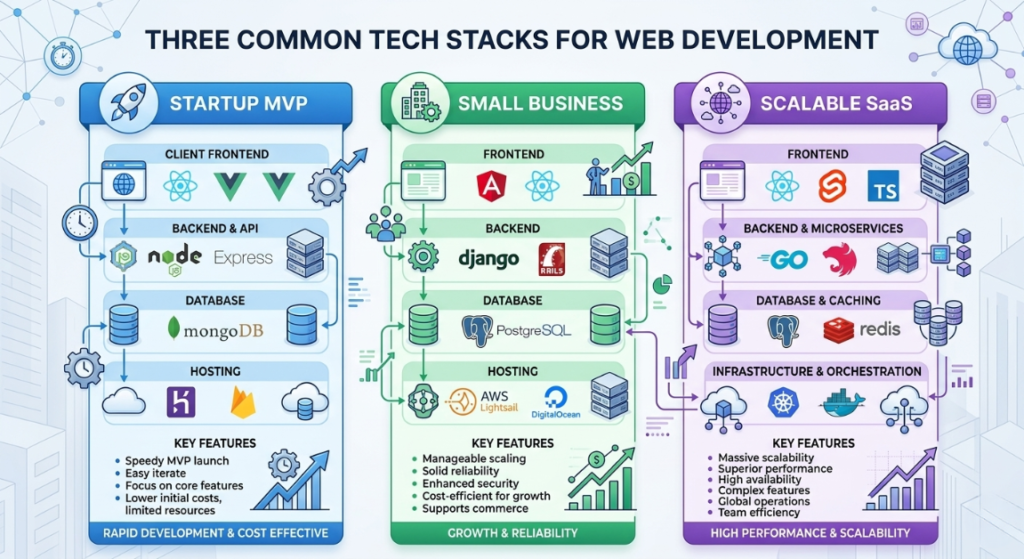
Sample Web App Tech Stacks
If you asked me to architect your project today based on MVP vs Full Product: What to Build First in 2026, here are three complete, real-world tech stack recommendations.
Stack 1: The “Bootstrapped Startup MVP” Stack
This stack is all about validating your idea without spending your kids’ college fund. It keeps Agile software development costs incredibly low.
- Frontend: React (built using an AI tool like v0)
- Backend: Supabase (Backend-as-a-Service)
- Database: PostgreSQL (via Supabase)
- Hosting: Vercel
- Estimated Cost: $20 – $50/month
- Best For: MVP startups who need to prove their concept fast and manage Agile software development costs tightly.
Stack 2: The “Service Business Operations” Stack
This is for the established small business that needs a reliable internal tool or customer portal that won’t crash when traffic spikes. Web App vs Mobile App in 2026: Which to Choose?
- Frontend: Next.js
- Backend: Node.js API routes (inside Next.js)
- Database: PostgreSQL (hosted on standard cloud)
- Hosting: DigitalOcean or AWS App Runner
- Estimated Cost: $40 – $100/month
- Best For: Service businesses with a steady customer base needing a reliable portal, balancing performance with Agile software development costs.
Stack 3: The “Funded Scalable SaaS” Platform
If you have seed funding, have already proven your MVP, and are ready to build the full, highly secure product, this is the gold standard.
- Frontend: React
- Backend: Python (Django)
- Database: PostgreSQL
- Hosting: AWS (Amazon Web Services)
- Estimated Cost: $100+ / month (Infrastructure only)
- Best For: SaaS startups transitioning from their initial prototype to a full-fledged enterprise product.
Cost Breakdown
Let’s talk numbers. When navigating MVP vs Full Product: What to Build First in 2026, the anxiety usually stems from the wallet. How much does all this actually cost?
It depends heavily on who is doing the work. The Complete Web Application Development Guide for Small Businesses (2026)
The Freelancer Route: Hiring a solo developer is great for an MVP. You can expect to pay anywhere from $2,000 – $10,000 for a solid, functional MVP. However, you will have to manage the project yourself, which means you need to be highly organized.
The Agency Route: If you hire a development agency, you are paying for project managers, QA testers, and designers. An agency MVP will start around $10,000, and a full custom web application will easily range from $25,000 – $50,000+.
Ongoing Costs (The Hidden Fees):
Do not forget the monthly bills.
- Hosting: $20 – $100/mo.
- Third-Party APIs: (e.g., Stripe for payments, Twilio for SMS) $10 – $50/mo.
- Maintenance: Bugs happen. Budget at least $200 – $500/mo for a developer on retainer to keep the lights on and update packages.
Related Articles You Might Like
If you found this guide useful, check out our article on how to choose a tech stack for web development projects, where we break down frameworks and tools for startups in even more detail. You might also enjoy our deep dive into managing freelance developers, and our 2026 guide to designing user interfaces that actually convert visitors into paying customers.
Frequently Asked Questions
When discussing MVP vs Full Product: What to Build First in 2026, these are the questions I get asked most often over a cup of coffee.
1. How long does it take to build a web application?
It entirely depends on the scope. A basic MVP using no-code tools or AI generators can be launched in 2 to 4 weeks. A custom-coded MVP using Next.js might take 2 to 3 months. If you are building a full, feature-rich web product with an agency, expect the timeline to stretch anywhere from 4 to 8 months. Speed to market is exactly why I recommend the MVP route first!
2. What is the best framework for beginners?
If you have absolutely no coding experience, do not start with a framework; start with a no-code tool like Bubble or Webflow. If you want to learn to code and build your app, React (specifically via Next.js) is the best place to start in 2026. It has the largest community, the most tutorials on YouTube, and it is what most AI tools generate automatically.
3. How much does a small business web app cost?
For a small business looking to build an internal tool, a customer portal, or an MVP, realistic costs range from $3,000 to $10,000 if you use a skilled freelancer. If you use a professional agency for a highly polished, full custom product, you should budget between $15,000 and $40,000. Remember to factor in roughly $50 to $100 a month for hosting and database fees.
4. Should I hire a developer or an agency?
Hire a freelance developer if you have a tight budget, a clear vision, and the time to manage the project daily. Freelancers are agile and cost-effective for an MVP. Hire an agency if you have a larger budget ($20k+), need complex design work, and want a hands-off experience where a project manager handles the stress for you.
5. What is the best database for web applications?
For 90% of small business web applications in 2026, PostgreSQL is the absolute best choice. It is open-source, incredibly powerful, highly secure, and scales effortlessly. You can easily host a PostgreSQL database using modern Backend-as-a-Service providers like Supabase, making it accessible even if you aren’t a database administrator.
Final Thoughts
Making the right call on MVP vs Full Product: What to Build First in 2026 doesn’t have to be a nightmare. Remember the restaurant analogy: don’t build a 500-seat flagship location until you’ve proven people love the food from your food truck.
Start small. Embrace the MVP. Use modern tools like AI code generators, BaaS platforms like Supabase, or robust frameworks like Next.js to get your idea into the hands of real users quickly and affordably. Validate your concept, listen to your customers, and let their feedback guide you toward building the ultimate full product.
How Much Does It Cost to Build a Simple Web App (2026 Guide)
You have a great idea. Now you have the roadmap to build it safely and smartly. The only question left regarding MVP vs Full Product: What to Build First in 2026 is: when are you going to start building?
Call To Action
Have you ever struggled with deciding what features to cut for your MVP? Or maybe you’ve tried one of the AI coding tools and want to share your results? Drop a comment below I read and reply to every single one!
eCommerce Website Cost for Small Business (2026 Guide)
If you want more practical, no-nonsense development advice delivered straight to your inbox, subscribe to our blog. And let me know: would you like me to help you draft a feature list for your upcoming MVP? Reach out, and let’s get building!
How to Accurately Budget for Web App Maintenance Costs in 2026
Leave a Reply