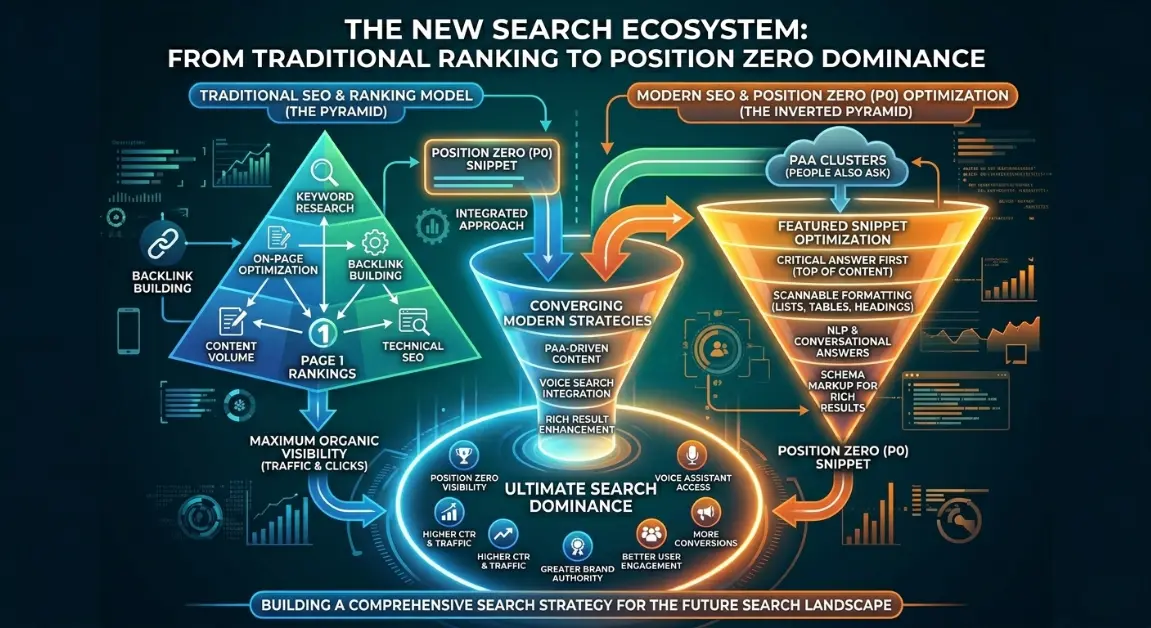
You’re ranking on page one. Position 3, maybe position 2. Decent traffic, solid content, but you’re invisible. Meanwhile, the site in position zero the featured snippet is capturing 8% of all clicks for that query, plus the authority of being “the answer” Google chose.
Here’s the brutal truth: position one without position zero is the new page two. In 2026, with AI Overviews pulling directly from featured snippets and voice assistants reading only the position zero answer, being anywhere else means you’re not being heard.
I see this constantly in audits. Great content, terrible structure. Walls of text buried under clever intros. Answers scattered across 2,000 words. No scannable formatting, no inverted pyramid structure, no optimization for People Also Ask (PAA). They’re writing for readers, not for answer engines.
After restructuring content specifically for how to structure content for featured snippets, I’ve seen pages jump from position 3 to position zero in 48 hours same content, different architecture. One client captured 34 featured snippets from existing articles in 90 days without writing a single new word.
This guide shows you exactly how to structure content for featured snippets to dominate position zero, capture People Also Ask placements, and become the voice search answer in 2026.
Why Featured Snippet Structure Matters for SEO Growth in 2026
Quick Answer (40-60 words): Featured snippet structure matters because position zero captures 8-10% CTR (double position 1), powers AI Overviews, and is the sole source for voice search answers. In 2026, Google’s inverted pyramid structure preference means content with direct 40-60 word answers, scannable formatting, and clear headers wins position zero regardless of traditional ranking. Without snippet optimization, you rank but remain invisible. Answer Engine Optimization (AEO)
The Position Zero Reality Check
Featured snippets aren’t just “nice to have” anymore they’re the primary visibility layer:
- AI Overviews Integration: Google’s AI-generated answers (powered by Gemini) pull directly from featured snippets. No snippet = no AI Overview inclusion = zero visibility in the new search experience.
- Voice Search Dominance: Smart speakers read only the featured snippet. Position 1 gets zero voice traffic; position zero gets 100%.
- People Also Ask Expansion: PAA boxes now appear for 65% of searches. Each expansion is a featured snippet opportunity. Structured content captures multiple PAA placements from one article.
- Click-Through Rate Reality: Position 1 averages 3-4% CTR. Position zero averages 8-10%. Being second in traditional rankings but first in snippets often beats being first in rankings alone.
Real Ranking Scenario: The Structure Makeover
A software comparison site ranked position 2 for “best project management software” solid, but they were losing 60% of potential clicks to the position zero snippet. Their content was comprehensive (4,500 words) but structurally broken: meandering intro, buried recommendations, no lists or tables.
The featured snippet restructuring: How to Structure Content for Featured Snippets
- Implemented inverted pyramid structure: direct 45-word answer in first paragraph
- Added scannable formatting: comparison table for top 5 tools
- Created H2 headers matching exact search queries
- Optimized for People Also Ask: added FAQ section with 8 related questions
Results after 30 days: How to Structure Content for Featured Snippets
- Position zero captured for “best project management software” (paragraph snippet)
- Position zero captured for “what is project management software” (definition snippet)
- Position zero captured for “project management software comparison” (table snippet)
- Total featured snippets from one article: 7
- Organic traffic increase: 240% (from 3,200 to 10,900 monthly visitors)
That’s the power of knowing how to structure content for featured snippets.
Understanding Featured Snippet Fundamentals
Quick Answer (40-60 words): Featured snippets are selected search results featured at the top of Google’s results, extracted from webpages to answer user queries directly. Types include paragraph snippets (40-60 words), list snippets (numbered or bulleted), and table snippets. Winning requires inverted pyramid structure (answer first), scannable formatting (headers, lists, tables), and precise query matching. Position zero is earned through structure, not just content quality. What is Passage Ranking How to Optimize for It
The Four Pillars of Snippet Structure
1. Inverted Pyramid Structure
Journalism’s golden rule adapted for SEO: most important information first. Answer the query in the first 40-60 words, then expand with details. Don’t bury the lede.
2. Scannable Formatting
Content designed for extraction: clear H2/H3 headers, bullet points for lists, tables for comparisons, short paragraphs. Google scans; make it easy.
3. Query-First Headers
H2s that match search queries exactly. If people ask “how many words should a featured snippet answer be,” that should be your H2, not “Optimal Word Count Considerations.”
4. People Also Ask (PAA) Optimization
Structuring content to capture the related questions Google displays. Each PAA is a separate snippet opportunity; comprehensive coverage wins multiple positions. Best Practices for Image SEO Optimization 2026
Advanced Featured Snippet Strategies That Actually Work
Quick Answer (40-60 words): Advanced strategies include the 40-60 word answer formula for paragraph snippets, list optimization with action verbs for “how to” queries, table structuring for comparison keywords, PAA domination through comprehensive FAQ sections, inverted pyramid writing for definition queries, and scannable formatting with proper HTML tags. Each targets specific snippet types with precise structural requirements. Best Internal Linking Strategy for SEO
Strategy 1: The 40-60 Word Answer Formula
What it is: Writing a concise, complete answer in exactly 40-60 words (optimal snippet length) immediately after the H2, designed for paragraph snippet extraction. What is Topical Authority How to Build It SEO
When to use: For “what is,” “why,” and “how” queries where Google displays paragraph snippets (60% of all snippets).
Pros: How to Structure Content for Featured Snippets
- Directly targets the most common snippet type
- Forces content clarity and precision
- Works for voice search (readable in ~15 seconds)
- Can be extracted regardless of overall page ranking
- Improves user experience (immediate answers)
Cons: How to Structure Content for Featured Snippets
- Requires discipline (no fluff in answer paragraph)
- May feel abrupt to readers wanting narrative
- Word count must be precise (under 40 = incomplete, over 60 = truncated)
- Needs entity-rich context to avoid ambiguity
Difficulty: Easy-Medium
Real Example: A health site targeted “what is intermittent fasting.” Original answer: 200 words buried in paragraph three. Restructured: 52-word direct answer immediately under H2: “Intermittent fasting is an eating pattern cycling between fasting and eating periods. Unlike diets restricting foods, it controls when you eat, typically involving 16-hour daily fasts or 24-hour fasts twice weekly. This triggers metabolic switching, burning fat after sugar depletion.” Result: Position zero within 72 hours, voice search answer for Google Assistant, cited in AI Overviews. Breadcrumb Schema Markup Implementation
The Formula: How to Structure Content for Featured Snippets
plainCopy
[Exact query or close variation]
[40-60 word direct answer]
– Definition or direct response in sentence one
– Key differentiator or mechanism in sentence two
– Brief context or scope in sentence three (if space allows)
[Expansion section – 300+ words of depth]
Word Count Targets: How to Structure Content for Featured Snippets
- 40 words: Minimum for complete answer (risk of “incomplete” label)
- 50 words: Optimal (most common snippet length)
- 60 words: Maximum (longer gets truncated with “…”)
Strategy 2: List Optimization for “How To” and Process Queries
What it is: Structuring step-by-step content as numbered or bulleted lists with action-verb headers, designed for list snippet extraction (25% of all snippets).
When to use: For “how to,” “steps to,” “best ways to,” and process-oriented queries. Essential for instructional content. What is Cannibalization in SEO How to Fix It
Pros: How to Structure Content for Featured Snippets
- Captures list snippets (prominent, high-CTR)
- Scannable for users (better UX)
- Can capture multiple PAA variations from one list
- Works for both short and long processes
- Natural fit for “best of” content
Cons: How to Structure Content for Featured Snippets
- Requires precise list formatting (HTML <ol> or <ul>)
- Number of items matters (Google prefers 5-10)
- Must use action verbs (not nouns) for maximum impact
- Can feel rigid for complex processes
Difficulty: Easy
Real Example: A DIY blog had “How to Paint a Room” as a 2,000-word narrative. Restructured into 8 numbered steps with action verbs: “1. Clear and Cover Furniture,” “2. Clean Walls Thoroughly,” “3. Tape Edges and Trim,” etc. Each step had 50-word explanation. Result: Position zero list snippet, 5 related PAA captures (“how to paint a room fast,” “how to paint a room without tape”), 180% traffic increase. How to Create SEO Friendly URL Structure 2026
List Optimization Rules: How to Structure Content for Featured Snippets
Numbered Lists (for processes, rankings):
- Use <ol> HTML tag (not just numbers in text)
- Start with action verbs: “Clear,” “Prepare,” “Apply,” not “Furniture,” “Walls,” “Paint”
- 5-10 items optimal (Google shows 5-7, “more items” link for longer)
- Each item: 5-10 words for header, 20-30 words for explanation
- Logical sequence (chronological, importance, or difficulty)
Bulleted Lists (for features, benefits, non-sequential):
- Use <ul> HTML tag
- Parallel structure (all noun phrases or all verb phrases)
- 5-7 items ideal
- Brief explanations (15-20 words) or standalone items
Example Transformation:
❌ Before (Narrative):
“First you need to get all your furniture out of the way or cover it with drop cloths so it doesn’t get paint on it. Then you should clean the walls because paint won’t stick to dirty surfaces…”
✅ After (Optimized List): How to Structure Content for Featured Snippets
plainCopy
How to Paint a Room in 8 Steps
1. Clear and Cover Furniture
Move furniture to room center and cover with drop cloths. Remove wall hangings and outlet covers.
2. Clean Walls Thoroughly
Wash walls with mild soap solution to remove dust and grease. Allow to dry completely.
[Continue with steps 3-8…]
Strategy 3: Table Structuring for Comparison Snippets
What it is: Creating HTML tables for comparison queries, with clear column headers and row labels, optimized for table snippet extraction (15% of snippets, but high value). How to Optimize for Mobile-First Indexing 2026
When to use: For “vs,” “comparison,” “difference between,” “features,” and price-focused queries. Essential for affiliate and review content.
Pros: How to Structure Content for Featured Snippets
- Highest CTR of all snippet types (users see value immediately)
- Captures high-intent commercial queries
- Can display 3+ competitors/features at once
- Sticky (harder for competitors to displace)
- Perfect for affiliate revenue (pre-qualifies clicks)
Cons: How to Structure Content for Featured Snippets
- Requires HTML table markup (not just visual tables)
- Must be genuinely comparative (not one-sided)
- Limited to 3-4 columns for mobile display
- Data must be accurate and updated
- Complex tables may not render as snippets
Difficulty: Medium
Real Example: An affiliate site had “Best CRM Software” as a long-form review. Added comparison table with columns: “Feature,” “Salesforce,” “HubSpot,” “Zoho,” “Pipedrive.” Rows: “Starting Price,” “Free Trial,” “Best For,” “Mobile App.” Result: Table snippet for “CRM software comparison,” “Salesforce vs HubSpot,” and “best CRM for small business.” CTR from snippet: 12% (vs. 4% for previous position 2 ranking). Affiliate revenue increased 220%. What is Core Web Vitals How to Improve Scores 2026
Table Optimization Rules: How to Structure Content for Featured Snippets
HTML Structure:
HTMLPreviewCopy
<table>
<thead>
<tr>
<th>Feature</th>
<th>Option A</th>
<th>Option B</th>
<th>Option C</th>
</tr>
</thead>
<tbody>
<tr>
<td>Price</td>
<td>$10/month</td>
<td>$20/month</td>
<td>Free</td>
</tr>
<!– More rows… –>
</tbody>
</table>
Best Practices:
- 3-4 columns maximum (mobile optimization)
- 5-10 rows optimal (comprehensive but scannable)
- First column: Attribute/feature being compared
- Header row: Clear, descriptive labels
- Data consistency: Same units/format for all cells
- Above fold: Place table in first 40% of content
- Caption: Use <caption> tag to describe table purpose
Strategy 4: People Also Ask (PAA) Domination
What it is: Structuring content to answer not just the primary query, but 5-10 related questions displayed in Google’s People Also Ask boxes, capturing multiple snippet opportunities from one article. Traditional SEO Foundation
When to use: For every pillar piece targeting competitive head terms. PAA optimization multiplies your snippet potential.
Pros: How to Structure Content for Featured Snippets
- One article can capture 5-15 snippet positions
- PAA boxes appear for 65% of searches (massive reach)
- Related questions often have lower competition
- Builds topical authority signals
- Future-proofs for AI search (PAA fuels AI Overviews)
Cons: How to Structure Content for Featured Snippets
- Requires comprehensive content (3,000+ words typically)
- Research-intensive (must identify all related questions)
- Can create content bloat if not edited well
- Needs careful internal linking to prevent cannibalization
- Maintenance (PAA questions change over time)
Difficulty: Medium
Real Example: A personal finance article targeted “how to save money.” Primary query captured, but they expanded to answer 12 PAA variations: “how to save money fast,” “how to save money on groceries,” “how to save money on a low income,” etc. Each became an H2 with 40-60 word answer. Result: Featured snippets for primary query PLUS 8 PAA questions, total organic traffic 340% increase, article cited in AI Overviews for 15 related queries.
PAA Research Process: How to Structure Content for Featured Snippets
- Search your primary keyword in incognito mode
- Extract all PAA questions (click each to expand and reveal more)
- Use AlsoAsked to visualize question trees and find variations
- Check AnswerThePublic for “vs,” “can,” “will,” “without” variations
- Analyze competitors: What PAA questions do they capture?
- Prioritize: Select 5-10 highest-value, most relevant questions
Content Structure for PAA: How to Structure Content for Featured Snippets
plainCopy
[Primary Query – 40-60 word answer]
[Expansion content…]
[PAA Question 1 – 40-60 word answer]
[Expansion…]
[PAA Question 2 – 40-60 word answer]
[Expansion…]
[Continue for 5-10 PAA questions…]
Strategy 5: Inverted Pyramid Writing for Definition Queries
What it is: Journalism’s inverted pyramid structure adapted for SEO: answer the “who, what, when, where, why, how” in the first paragraph, then expand with details, context, and related information.
When to use: For “what is,” “who is,” “where is,” and definition queries. Essential for informational content and glossaries.
Pros: How to Structure Content for Featured Snippets
- Matches Google’s extraction algorithm perfectly
- Improves user satisfaction (immediate answers)
- Reduces bounce rate (users stay for depth after getting answer)
- Works for voice search (complete answer in first paragraph)
- Professional, journalistic tone builds authority
Cons: How to Structure Content for Featured Snippets
- Requires writing discipline (resist the narrative setup)
- Can feel abrupt if overdone
- May sacrifice storytelling for efficiency
- Needs balance to keep readers engaged beyond first paragraph
Difficulty: Medium
Real Example: A biographical article on “Who is Elon Musk” originally started with his childhood and education (chronological narrative). Restructured with inverted pyramid: first paragraph covered who he is, current roles, and primary significance (52 words). Then expanded chronologically. Result: Position zero for “who is Elon Musk,” voice search answer, and Knowledge Panel reference.
Inverted Pyramid Structure: How to Structure Content for Featured Snippets
plainCopy
Paragraph 1 (Lead): Complete answer to query
– Who/what is the subject?
– What is the key fact/definition?
– Why does it matter?
Paragraphs 2-3 (Context): Supporting details
– Background information
– Key statistics or dates
– Scope or significance
Remaining Content (Depth): Comprehensive coverage
– History, examples, case studies
– Related concepts, comparisons
– Expert opinions, data analysis
Strategy 6: Scannable Formatting with Semantic HTML
What it is: Using proper HTML tags (not just visual styling) to create content that Google’s crawlers can parse and extract accurately: <h2> for sections, <ol>/<ul> for lists, <table> for comparisons, <strong> for emphasis.
When to use: For all content targeting featured snippets. Proper HTML is the foundation; without it, Google can’t extract your structure.
Pros: How to Structure Content for Featured Snippets
- Enables accurate snippet extraction
- Improves accessibility (screen readers)
- Future-proofs for AI parsing
- Better mobile rendering
- Required for valid schema markup
Cons: How to Structure Content for Featured Snippets
- Requires HTML knowledge or proper CMS use
- Visual editors may strip semantic markup
- More time-intensive than visual formatting
- Must validate (Screaming Frog, W3C)
- Can break if theme/CSS conflicts
Difficulty: Easy-Medium
Real Example: A recipe site used visual formatting (bold text, line breaks) instead of semantic HTML for ingredient lists and steps. Google couldn’t extract structured data. After converting to proper <ul> for ingredients and <ol> for steps (with schema markup), they captured recipe snippets for 45 dishes, appeared in Google Assistant voice results (“how do I make chocolate chip cookies”), and gained 280% recipe card visibility.
Semantic HTML Checklist:
Table
| Element | Use For | Snippet Impact |
| <h1> | Page title (one only) | Primary topic signal |
| <h2> | Main sections | Snippet section boundaries |
| <h3> | Subsections | Nested snippet opportunities |
| <ol> | Numbered steps/rankings | List snippet extraction |
| <ul> | Bulleted features/benefits | List snippet extraction |
| <table> | Comparisons/data | Table snippet extraction |
| <strong> | Emphasis within text | Entity highlighting |
| <p> | Paragraphs | Paragraph snippet boundaries |
Validation:
- Screaming Frog crawl to check header hierarchy (no H2 without H1, no H3 without H2)
- W3C Markup Validator for HTML errors
- Google’s Rich Results Test for structured data
Common Featured Snippet Mistakes to Avoid
Quick Answer (40-60 words): Critical mistakes include burying answers in long introductions (violating inverted pyramid structure), using visual formatting instead of semantic HTML, targeting keywords instead of exact queries in headers, creating lists without action verbs, building tables with more than 4 columns, ignoring People Also Ask opportunities, and writing answers under 40 or over 60 words.
Mistake 1: The Buried Answer
Writing 300 words of intro before answering the query. Google extracts the first relevant passage if that’s your fluff, you lose.
Fix: Inverted pyramid structure. Answer in first 40-60 words. No exceptions.
Mistake 2: Visual Formatting Faux Pas
Using bold text and line breaks instead of <ol>, <ul>, and <table>. Google sees a paragraph, not a list.
Fix: Semantic HTML. Use proper tags, validate with Screaming Frog.
Mistake 3: Generic Headers
Using “Introduction,” “Overview,” “Details” instead of exact query matches.
Fix: Query-first H2s. If people ask “how many words should a featured snippet answer be,” use that as your H2.
Mistake 4: Noun-Heavy Lists
Writing “Furniture, Walls, Paint” instead of “Clear Furniture, Clean Walls, Apply Paint.”
Fix: Action verbs for every list item. Start with verbs, not nouns.
Mistake 5: Table Bloat
Creating 8-column comparison tables that won’t render on mobile or as snippets.
Fix: 3-4 columns maximum. Prioritize the most important comparison points.
Mistake 6: PAA Neglect
Answering only the primary query and ignoring the 10 related questions in PAA boxes.
Fix: Comprehensive coverage. Research PAA questions, add H2s for each.
Featured Snippet Tools Comparison
Table
| Tool | Best For | Difficulty | Cost | Rating |
| AlsoAsked | PAA research, question trees for snippet expansion | Easy | Low ($15/mo) | ⭐⭐⭐⭐⭐ |
| Ahrefs | Featured snippet tracking, SERP feature analysis, opportunity identification | Medium | High ($99+/mo) | ⭐⭐⭐⭐⭐ |
| SEMrush | Position tracking for snippets, content optimization recommendations | Medium | High ($119+/mo) | ⭐⭐⭐⭐ |
| Google Search Console | Identifying snippet opportunities (queries with impressions but no clicks) | Easy | Free | ⭐⭐⭐⭐⭐ |
| Screaming Frog | HTML validation, header structure audit, semantic markup checking | Medium | Medium ($259/yr) | ⭐⭐⭐⭐⭐ |
| AnswerThePublic | Long-tail question discovery for PAA expansion | Easy | Medium ($99/mo) | ⭐⭐⭐⭐ |
| Schema Markup Validator | Testing structured data for enhanced snippet eligibility | Easy | Free | ⭐⭐⭐⭐⭐ |
Pro tip: Start with Google Search Console (free) + AlsoAsked ($15/mo) for PAA research. Add Ahrefs when ready to track snippet ownership. Use Screaming Frog monthly to validate HTML structure.
Sample Featured Snippet Strategy Stacks
Stack 1: Beginner Snippet Stack (Budget: $0-30/month)
Goal: Capture first featured snippets with minimal investment
Strategy:
- Research: People Also Ask mining (free) + AlsoAsked basic
- Structure: Inverted pyramid for all new content (40-60 word answers)
- HTML: Use WordPress block editor properly (Heading blocks, List blocks, Table blocks)
- Content: Target 5 low-competition “what is” and “how to” queries
- Tools: Google Search Console (free) + Screaming Frog free tier
- Success metric: 3 featured snippets within 60 days
Example: A local gardening blog targets “how to prune roses,” “when to plant tomatoes,” “what is companion planting.” Each article: 50-word answer first, then expansion. Uses proper Heading 2 and List blocks. Result: Captures snippets for all three, voice search answers for Google Home, 150% traffic increase.
Stack 2: Affiliate Snippet Stack (Budget: $100-300/month)
Goal: Dominate commercial queries through comparison snippets
Strategy:
- Tools: Ahrefs Basic + AlsoAsked + Schema markup plugins
- Content: Comparison tables for “best ” queries with affiliate links
- Structure: Table snippets for comparisons, list snippets for “top 5” rankings
- Schema: Product + Review + FAQ schema for rich results
- PAA: Target 10 related questions per buying guide
- Success metric: Position zero for 50% of target commercial keywords
Example: A tech review site creates “Best Wireless Earbuds 2026” with comparison table (price, battery, rating) and “Top 5” list with affiliate links. Targets PAA: “what are the best wireless earbuds for running,” “how long do wireless earbuds battery last.” Captures table snippet for primary query, list snippet for “top 5,” and 4 PAA placements.
Stack 3: Enterprise Snippet Stack (Budget: $500-1000/month)
Goal: Scale featured snippet capture across 1000+ pages
Strategy:
- Tools: Ahrefs + SEMrush + custom PAA tracking + Screaming Frog
- Audit: Identify all existing content ranking positions 2-10 (snippet opportunities)
- Automation: Template-based snippet optimization for content teams
- Schema: Dynamic FAQ and HowTo schema injection
- Monitoring: Dashboard tracking snippet share by topic cluster
- Retrofitting: Dedicated team updating 50 articles/week with snippet structure
- Success metric: 60% snippet share of voice for target topic clusters
Example: A health publisher with 3,000 articles. Automated snippet opportunity identification (position 2-10, high volume, no current snippet). Content team adds 40-60 word answers and PAA sections. Result: 800+ featured snippets captured, 45% of health queries in their niche show their snippets, cited in AI Overviews for 200+ queries.
Featured Snippet Cost Breakdown
Quick Answer (40-60 words): Featured snippet optimization costs $500-8,000 depending on scale. Main costs: research tools ($50-300/month), content restructuring ($500-5,000), schema implementation ($300-2,000), and ongoing optimization ($500-1,500/month). However, position zero typically increases CTR 150-300% over position 1, delivering 400-1000% ROI within 6 months.
Investment Tiers
Table
| Component | Starter ($500-1K) | Growth ($1K-5K) | Enterprise ($5K+) |
| Tools (12 months) | $300 (AlsoAsked + basics) | $2,400 (Ahrefs + SEMrush) | $6,000+ (enterprise suite) |
| Content Restructure | $500 (DIY restructure) | $3,000 (VA/freelancer) | $15,000+ (dedicated team) |
| Schema Implementation | $300 (basic FAQ schema) | $2,000 (dynamic structured data) | $10,000+ (custom development) |
| New Snippet Content | $1,000 (10 articles) | $5,000 (20 optimized articles) | $20,000+ (100+ articles) |
| Total Year 1 | $2,100 | $12,400 | $51,000+ |
ROI Reality: A $2,000 snippet optimization investment capturing 5 featured snippets averaging 1,500 monthly searches at position zero (8% CTR) vs. position 2 (3% CTR) = 75 additional monthly visitors per snippet = 375 total. At $0.12 CPC value = $540/month. Break-even in 4 months, 320% ROI year one. This ignores brand authority and voice search value.
Related Articles (Internal Linking Suggestions)
- AEO: Answer Engine Optimization Guide (link from “featured snippets”)
- Schema Markup for SEO: Structured Data Guide (link from “schema markup”)
- Voice Search Optimization: Smart Speaker SEO (link from “voice search”)
- People Also Ask: PAA Optimization Strategy (link from “People Also Ask”)
- Inverted Pyramid Writing for Web Content (link from “inverted pyramid structure”)
- Semantic HTML for SEO: Proper Tagging (link from “scannable formatting”)
- Knowledge Panel Optimization: Entity SEO (link from “Knowledge Panel”)
What Most SEO Experts Get Wrong About Featured Snippets
The Myth: “You need to rank #1 to win the featured snippet.”
The Reality: Google pulls snippets from any position on page one often position 3, 4, or 5. I’ve seen position 5 content capture snippets over position 1 because the structure was better. The snippet is about answer suitability, not ranking position. Optimize your structure even if you’re not #1 yet. In fact, snippet capture often improves your ranking because Google trusts your content more.
The Myth: “Once you have a snippet, you keep it forever.”
The Reality: Featured snippets are volatile. The average snippet hold time is 2-4 weeks in competitive niches. You lose snippets when competitors optimize better or when your content becomes outdated. Snippet optimization isn’t “set and forget” it’s continuous monitoring and updating. Use Ahrefs or SEMrush to track snippet ownership weekly and re-optimize when you lose position zero.
The Myth: “Snippets hurt CTR because users get answers without clicking.”
The Reality: Paragraph snippets often increase CTR (users want more detail). List and table snippets have variable impact some users get enough from the snippet, others click for full context. But even “zero-click” snippets build brand authority and voice search presence. Plus, losing a snippet to a competitor definitely hurts more than having one. The goal isn’t just clicks it’s visibility and authority.
The Myth: “You should optimize every article for snippets.”
The Reality: Not every query generates a snippet. Informational queries (“what is,” “how to”) have high snippet rates. Navigational queries (“Facebook login”) and transactional queries (“buy running shoes”) rarely do. Focus snippet optimization on content targeting informational intent with question-based queries. Don’t waste effort on snippet optimization for pages where Google doesn’t show snippets.
CTR Optimization for Featured Snippet Content
Title Variations for Testing
- Primary: How to Structure Content for Featured Snippets 2026 (59 chars)
- Variation A: Featured Snippet Optimization: Structure Guide 2026 (57 chars)
- Variation B: Win Position Zero: Content Structure Guide 2026 (56 chars)
Meta Description Variations
- Primary: Learn how to structure content for featured snippets in 2026. Master position zero with inverted pyramid writing, scannable formatting, and PAA optimization. (160 chars)
- Variation: Structure your content to win featured snippets and position zero. Inverted pyramid, scannable formatting, and People Also Ask strategies. (155 chars)
Internal Linking Strategy: Anchor Text Suggestions
For linking FROM this article:
- “position zero” → Link to position zero domination guide
- “inverted pyramid structure” → Link to journalistic writing for SEO
- “People Also Ask (PAA)” → Link to PAA optimization strategy
- “scannable formatting” → Link to semantic HTML guide
- “Knowledge Panel” → Link to entity SEO and Knowledge Panel optimization
For linking TO this article:
- “how to structure content for featured snippets“
- “featured snippet optimization guide”
- “position zero content structure”
- “inverted pyramid SEO writing”
- “People Also Ask optimization”
Content Scaling Layer: Reusable Template
This structure scales to 100+ featured snippet articles:
Template Components:
- SEO Metadata (customize for snippet target)
- Struggle hook (position zero pain point)
- “Why This Matters” (snippet/AI/voice trends)
- Fundamentals (4-5 snippet core concepts)
- 5-7 Strategy H3s (What/When/Pros/Cons/Difficulty/Example format)
- Mistakes section (snippet-specific errors)
- Tools table (snippet research tools)
- Strategy stacks (3 tiers: beginner/pro/enterprise)
- Cost breakdown (adjusted for complexity)
- “What Experts Get Wrong” (snippet myths)
- CTR variations (3 titles, 2 descriptions)
- Internal linking (5 anchors in/out)
- FAQs (5 questions with 40-60 word answers)
- Final thoughts + CTA
Scaling Workflow:
- Research PAA questions for target keyword
- Create inverted pyramid outline (answer first, then PAA sections)
- Write 40-60 word answers for each H2
- Add scannable formatting (lists, tables where relevant)
- Implement semantic HTML and schema markup
- Cross-link to snippet pillar using “featured snippets” anchor
FAQs: Featured Snippet Optimization
How many words should a featured snippet answer be?
Direct Answer: Featured snippet answers should be 40-60 words for paragraph snippets, 5-10 items for list snippets, and 3-4 columns by 5-10 rows for table snippets.
Detailed Explanation: Google’s paragraph snippets typically display 40-60 words (approximately 300-450 characters). Under 40 words often appears incomplete; over 60 words gets truncated with “…” List snippets show 5-7 items with “More items” link for longer lists. Table snippets display 3-4 columns optimally. These lengths aren’t arbitrary they fit Google’s answer box dimensions and voice search reading times (15-20 seconds). Target 50 words for paragraph snippets (optimal middle ground), 7-8 items for lists, and concise table cells. Test your answer by reading it aloud if it takes under 15 seconds, length is likely appropriate.
What are the best HTML tags for featured snippet lists?
Direct Answer: Use <ol> (ordered list) for numbered steps/rankings and <ul> (unordered list) for bulleted features. Avoid visual formatting (bold, line breaks) instead of semantic HTML.
Detailed Explanation: Google’s extraction algorithm specifically looks for <ol> and <ul> HTML tags to identify list content. Using numbers or bullets with visual formatting (CSS, manual typing) instead of semantic tags prevents proper extraction. For “how to” and ranking queries, use <ol> with <li> items starting with action verbs. For features and non-sequential items, use <ul>. Ensure lists are inside your content body, not in sidebars or footers. Validate your HTML with Screaming Frog to confirm proper list structure. Additionally, use <table> with <thead> and <tbody> for comparison snippets never use images of tables or visually formatted text tables.
How do I optimize existing blog posts for position zero?
Direct Answer: Identify posts ranking positions 2-10, add 40-60 word direct answers immediately after H2s, restructure with inverted pyramid format, convert narratives to lists/tables where appropriate, and add PAA sections with related questions.
Detailed Explanation: Retrofitting existing content is often the fastest way to win snippets. Process: (1) In Google Search Console, find pages with high impressions but position 2-10 rankings these are snippet opportunities; (2) Restructure with inverted pyramid: move the answer to the first paragraph, cut lengthy intros; (3) Add “Answer” sections: create H2s that match exact queries with 40-60 word answers; (4) Convert to lists: change narrative steps to <ol> or <ul> with action verbs; (5) Add tables: create comparison tables for vs/comparison queries; (6) PAA expansion: research People Also Ask questions, add H2s for top 5; (7) Validate HTML: ensure semantic markup with Screaming Frog; (8) Submit for reindexing in GSC. Focus on pages already ranking well snippet optimization is the final 10% that pushes them to position zero.
What’s the difference between featured snippets and Knowledge Panels?
Direct Answer: Featured snippets are extracted from webpages to answer specific queries. Knowledge Panels are information boxes about entities (people, places, things) drawn from Google’s Knowledge Graph, not necessarily from your website.
Detailed Explanation: Featured snippets appear at the top of search results (position zero) and cite a specific webpage as the source. They’re answer-focused and query-dependent. Knowledge Panels appear on the right side (desktop) or top (mobile) and provide entity information biographical data for people, business details for companies, facts about places. Knowledge Panels draw from Google’s Knowledge Graph (structured data from multiple sources) and don’t necessarily cite your site, though you can influence them with schema markup and entity SEO. For businesses and personal brands, target both: featured snippets for answer queries, Knowledge Panels for entity recognition. They complement each other in search visibility.
Can I lose traffic by winning a featured snippet?
Direct Answer: Sometimes. Paragraph snippets may reduce clicks for simple queries, but list and table snippets often increase CTR. Overall, snippet benefits (brand authority, voice search, stability) usually outweigh potential click loss.
Detailed Explanation: “Zero-click” searches occur when users get answers from snippets without visiting websites. This is most common for simple factual queries (“what time is it in London,” “how many ounces in a cup”). For these, snippet optimization builds brand awareness even without clicks. However, for complex queries (“how to start a business,” “best CRM software”), snippets often increase CTR users want the full guide after seeing the preview. Lists and tables have mixed impact; some users get enough information, others click for details. Strategy: Target snippets for high-intent, complex queries where users need more depth. Monitor CTR in Google Search Console after winning snippets if CTR drops significantly, your answer may be too complete. Adjust by making the snippet compelling but incomplete, driving clicks for full information.
Final Thoughts: Your Featured Snippet Action Plan
Knowing how to structure content for featured snippets isn’t about gaming Google it’s about aligning with how search works in 2026. Users want answers, not essays. Google wants to provide them. Your job is to package your expertise so it can be extracted, displayed, and heard.
Your 30-day snippet roadmap:
Days 1-7: Audit existing content. Use Google Search Console to find pages ranking positions 2-10. Check if they have 40-60 word direct answers and proper HTML structure.
Days 8-14: Retrofit your top 3 opportunities. Add inverted pyramid structure, 50-word answers, and semantic HTML. Submit for reindexing.
Days 15-21: Create one new snippet-optimized article from scratch. Research PAA questions, use query-first H2s, implement scannable formatting.
Days 22-30: Monitor results. Check if your retrofitted content wins snippets. Analyze which formats (paragraph, list, table) work for your niche. Refine and repeat.
Featured snippets are the most democratic aspect of SEO. You don’t need the most backlinks or the highest domain authority. You need the best-structured answer. A position 5 page with perfect snippet structure beats a position 1 page with terrible structure.
Start with the audit. Restructure with the inverted pyramid. Write the 40-60 word answers. The position zero is yours for the taking.
Call to Action
Ready to capture your first featured snippet? Start with a free audit in Google Search Console. Find one page ranking position 2-10 for a “what is” or “how to” query. Restructure it with a 50-word direct answer immediately under the H2, add a list or table if relevant, and submit it for reindexing this week.
Have questions about your specific snippet optimization challenges? Whether you’re struggling to displace a competitor’s snippet, optimizing for PAA domination, or scaling snippet structure across a content team, the principles remain: answer first, structure clearly, and target the query exactly. Audit first, then optimize for position zero.
Traditional SEO Foundation vs Answer Engine Optimization (AEO)
Leave a Reply