“So, how much does it cost to build a simple web app?”
I get this question a lot. I’m usually sitting across from a founder, coffee in hand, and they have this brilliant idea a new way to book appointments, a simple tool for managing inventory, or the next big SaaS product. They’re excited, and they should be. But then comes the big, intimidating question of cost. The internet gives you a range from a few thousand dollars to a few hundred thousand, which isn’t helpful.
The truth is, the cost is a “it depends” situation. But it doesn’t have to be a mystery. My goal with this article is to demystify the process for you. We’ll talk about what really goes into building a web application, how much does it cost to build a simple web app from the technology choices to the people you hire. We will explore everything from what a web app MVP development cost looks like to the tricky, often overlooked web app maintenance fees.
By the end of this, you’ll have a much clearer picture of how much it costs to build a simple web app and be able to walk into a conversation with a developer with confidence.
Why This Matters for Small Businesses how much does it cost to build a simple web app
Getting the budget wrong is one of the most common mistakes I see small businesses make. They either underestimate the cost and run out of money halfway through, or they over-engineer a solution they don’t need and burn through cash.
I once worked with a restaurant owner who wanted a custom online ordering system. He’d been quoted a huge figure by an agency and was about to give up. We sat down, and I explained that for his needs, he didn’t need a massive, custom-built platform. We scoped out a simpler, more focused application. The result? He got his ordering system for a fraction of the initial quote and was able to launch in under two months how much does it cost to build a simple web app.
Understanding how much it cost to build a simple web app is not just about a number; it’s about making smart, strategic decisions for your business. It ensures you invest your resources wisely and build a tool that actually serves your goals.
Understanding the Basics: What’s in a Web App?
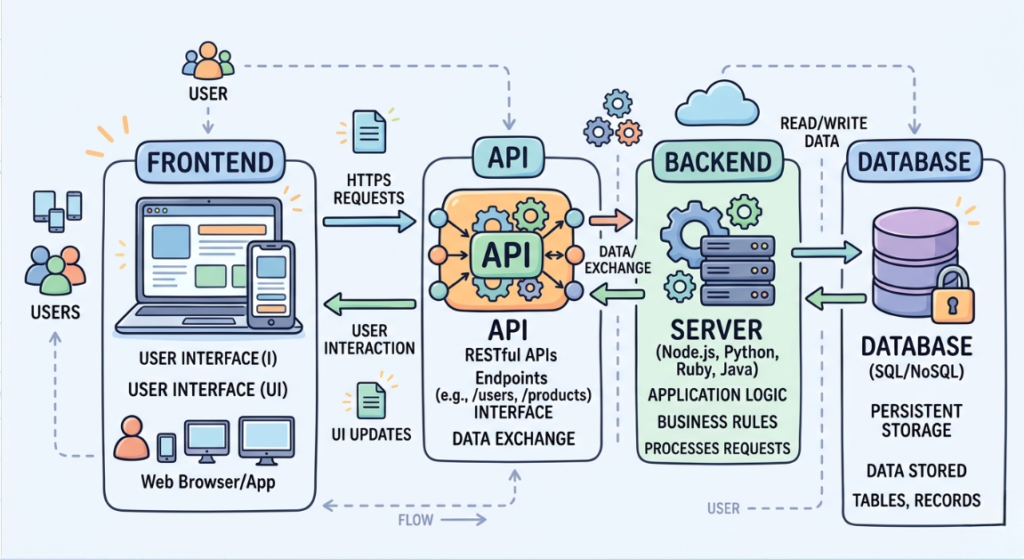
Let’s quickly break down the moving parts of a web application. Think of it like a restaurant how much does it cost to build a simple web app.
- Frontend (The Dining Area): This is everything your customer sees and interacts with the menus, the tables, the decor. In web terms, this is the user interface (UI) built with technologies like HTML, CSS, and JavaScript. It’s what makes your app look good and feel intuitive.
- Backend (The Kitchen): This is where the magic happens. The backend is the server, the database, and the application logic. It processes orders (requests), manages data (inventory, user accounts), and communicates with other systems. You don’t see it, but it powers everything.
- Database (The Pantry): This is where all your ingredients and supplies are stored. For a web app, the database holds all the data: user information, product details, order history, etc.
- APIs (The Waitstaff): APIs (Application Programming Interfaces) are the messengers that connect the frontend and backend. They take the customer’s order to the kitchen and bring the food back to the table.
- Hosting (The Building): This is the physical (or virtual) space where your restaurant lives. It’s the server where your application’s files are stored and from where they are served to users.
These components together form your “tech stack.” Choosing the right stack is a big part of determining how much it costs to build a simple web app.
Key Options & Technologies Explained
The technologies you choose have the biggest impact on your project’s cost and timeline. Here’s a look at some of the most common options in 2026.
Frontend Frameworks: React vs. Next.js how much does it cost to build a simple web app
Overview
React is a library for building user interfaces, while Next.js is a framework built on top of React. Think of React as a box of LEGOs, and Next.js as a LEGO kit with instructions and pre-sorted pieces for building a house.
Best For
- React: Highly interactive, self-contained applications where SEO is not the primary concern (like an internal dashboard).
- Next.js: Business websites, e-commerce stores, and any application that needs good SEO performance and fast page loads.
Pros & Cons
| Technology | Pros | Cons |
| React | – Extremely flexible- Huge community- Great for interactive UIs | – Requires more setup for a full application- SEO can be challenging |
| Next.js | – Excellent SEO out-of-the-box- Faster performance- Built-in routing and server features | – Slightly more opinionated- Can be overkill for very simple, internal tools |
Estimated Cost
The cost is more tied to the developer’s skill than the framework itself, but building a production-ready app with routing and server-side rendering is generally faster with Next.js. how much does it cost to build a simple web app.
Real-World Use Case
A local bakery’s website with a blog and online ordering would be a perfect fit for Next.js to ensure it ranks well on Google. An internal tool for managing that bakery’s inventory could be built with just React.
Backend Frameworks: Node.js vs. Python (Django)
Overview
Node.js allows you to run JavaScript on the server, which is great if your team already knows JavaScript. Django is a powerful, “batteries-included” framework for the Python language, known for its speed of development and security.
Best For
- Node.js: Real-time applications like chat apps, and for teams that want to use JavaScript for both frontend and backend how much does it cost to build a simple web app.
- Django: Data-heavy applications, how much does it cost to build a simple web app platforms requiring strong security (like fintech), and projects that need to be built very quickly.
Pros & Cons
| Technology | Pros | Cons |
| Node.js | – Fast and scalable for many connections- Uses JavaScript everywhere- Large ecosystem of packages (npm) | – Can be less structured, requiring more setup- Not ideal for CPU-intensive tasks |
| Django | – “Batteries-included” (admin, auth, etc.)- Highly secure- Fast development cycle | – Can be monolithic and less flexible- Performance may not match Node.js in some real-time scenarios |
Estimated Cost
Developer rates for both are comparable. However, Django’s built-in features can sometimes reduce the overall development time and, therefore, the custom how much does it cost to build a simple web app 2026.
Real-World Use Case
A social media app with a live feed would benefit from Node.js’s ability to handle many simultaneous connections. A complex how much does it cost to build a simple web app e-commerce site with an admin panel for managing products and orders could be built very efficiently with Django.
Databases: MongoDB vs. PostgreSQL
Overview
PostgreSQL is a traditional, relational database (think spreadsheets with rows and columns) how much does it cost to build a simple web app. It’s known for reliability and data integrity. MongoDB is a NoSQL, document-based database (think a collection of flexible JSON files), praised for its flexibility.
Best For
- PostgreSQL: Applications where data integrity is critical how much does it cost to build a simple web app (finance, booking systems) and you have structured data.
- MongoDB: Startups with rapidly evolving requirements, content management systems, and applications with unstructured or semi-structured data.
Pros & Cons
| Technology | Pros | Cons |
| PostgreSQL | – ACID compliant (very reliable)- Powerful for complex queries- Mature and stable | – Requires a defined structure (schema)- Less flexible for rapid changes |
| MongoDB | – Highly flexible schema- Scales out horizontally easily- Great for rapid prototyping | – Less strict on data integrity- Complex queries can be less performant than in SQL |
Estimated Cost
Both are open-source and free to use, so the cost is in the developer’s time and the hosting. For most simple web apps, how much does it cost to build a simple web app either will work well, and PostgreSQL is often considered a safer default choice today.
Real-World Use Case
A banking application needs the strict transactional integrity of PostgreSQL. A blog platform where each post might have different custom fields would benefit from MongoDB’s flexibility. The Complete Web Application Development Guide for Small Businesses (2026)
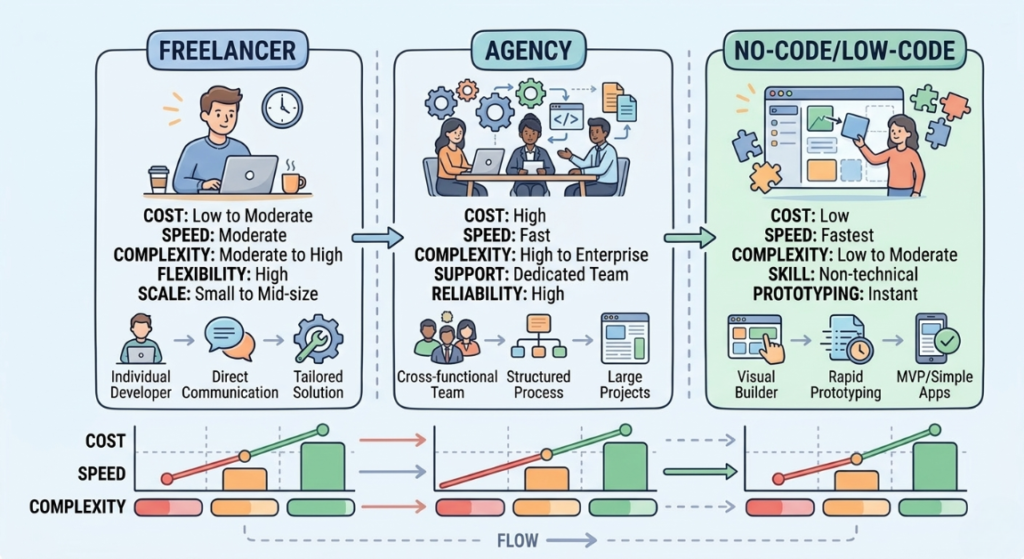
Development Approaches: Freelancers vs. Agencies vs. No-Code
Overview
- Freelancers: Hiring an individual developer.
- Agency: Hiring a full team (developers, designers, project managers).
- No-Code: Using platforms like Bubble or Webflow to build an app without writing code.
Best For
- Freelancers: Small, well-defined projects and MVPs.
- Agency: Larger, more complex projects that require a coordinated team.
- No-Code: Very simple MVPs, internal tools, and prototypes to validate an idea.
Estimated Cost
- Freelancer: $2,000 – $15,000 for a simple app.
- Agency: $15,000 – $50,000+ for a simple app.
- No-code web app development price: $500 – $5,000 for the build, plus monthly platform fees.
Options to Avoid (Common Mistakes) how much does it cost to build a simple web app
Part of knowing how much it costs to build a simple web app is knowing what not to do. Here are a few mistakes I see business owners make that inflate their costs.
- Over-engineering the MVP: Your first version (Minimum Viable Product) should be simple. Its only job is to test your core idea. I’ve seen founders spend six months building features that their first users never even touch.
- What to do instead: Focus on the one or two core features that solve a real problem for your users. Launch it, get feedback, and then decide what to build next. This is key to managing your web app MVP development cost.
- Ignoring Scalability: You might be tempted to go with the absolute cheapest hosting or a database structure that works for 100 users but will crumble at 10,000.
- What to do instead: Have a conversation with your developer about future needs. A little bit of planning upfront can save you a very expensive and painful migration later.
- Choosing a Niche Technology: It can be tempting to use the newest, trendiest framework. But if only a handful of developers know how to use it, hiring and maintenance will be a nightmare.
- What to do instead: Stick with well-established, popular technologies like the ones listed above. They have large communities, plenty of documentation, and a bigger talent pool.
Technology Comparison Table
Here’s a quick-glance table to help you compare your options: how much does it cost to build a simple web app What is Responsive Web Design and Why It Matters 2026
| Technology | Best For | Difficulty | Cost | Business Rating |
| Next.js | Public-facing sites (SEO) | Easy | Low | ⭐⭐⭐⭐⭐ |
| Node.js | Real-time features | Medium | Medium | ⭐⭐⭐⭐ |
| Django | Data-heavy apps, fast builds | Medium | Medium | ⭐⭐⭐⭐ |
| PostgreSQL | Structured, critical data | Medium | Low | ⭐⭐⭐⭐⭐ |
| MongoDB | Flexible, evolving data | Easy | Low | ⭐⭐⭐⭐ |
| No-Code | Simple MVPs, prototypes | Very Easy | Very Low | ⭐⭐⭐ |
Rating meaning:
- ⭐⭐⭐⭐⭐ = Excellent for most small businesses.
- ⭐⭐⭐⭐ = A solid choice in the right situation.
- ⭐⭐⭐ = Situational; good for specific, limited use cases.
- ⭐⭐ = Use with caution.
- ⭐ = Generally avoid for beginners or business-critical apps.
Sample Web App Tech Stacks for 2026
To make this more concrete, here are three common tech stacks and their estimated hosting costs. What is API Integration in Web Development Explained (2026)
Stack 1: The Lean Startup MVP Stack
- Frontend: React
- Backend: Node.js
- Database: MongoDB
- Hosting: Vercel
- Estimated Hosting Cost: $20 – $50/month
- Best For: SaaS MVPs where you need to move fast and the data structure might change.
Stack 2: The Small Business Workhorse
- Frontend: Next.js
- Backend: Next.js API Routes
- Database: PostgreSQL
- Hosting: DigitalOcean / AWS
- Estimated Hosting Cost: $40 – $100/month
- Best For: Service businesses, e-commerce sites, and content-driven platforms that need reliability and SEO.
Stack 3: The Scalable SaaS Platform
- Frontend: React
- Backend: Python (Django)
- Database: PostgreSQL
- Hosting: AWS
- Estimated Hosting Cost: $100+/month (scales with usage)
- Best For: Mature SaaS products that handle complex data and need robust security and administration tools.
Web App vs Mobile App in 2026: Which to Choose?
Cost Breakdown: The Real Numbers
So, what’s the final number? Here are some realistic ranges for building a simple custom web application in 2026.
- Freelancer / Small Team: $5,000 – $25,000
- This often involves hiring a freelance developer or a small, focused team. This is a good range for an MVP or a straightforward business tool. The cost of hiring a freelance web developer for a small project can vary greatly based on their location and experience.
- Development Agency: $25,000 – $75,000+
- An agency provides a full team: project managers, designers, and multiple developers. This is for more polished products or businesses that want a hands-off partner.
Don’t Forget the Hidden Costs!
The initial build is just one part of the puzzle. You also need to budget for:
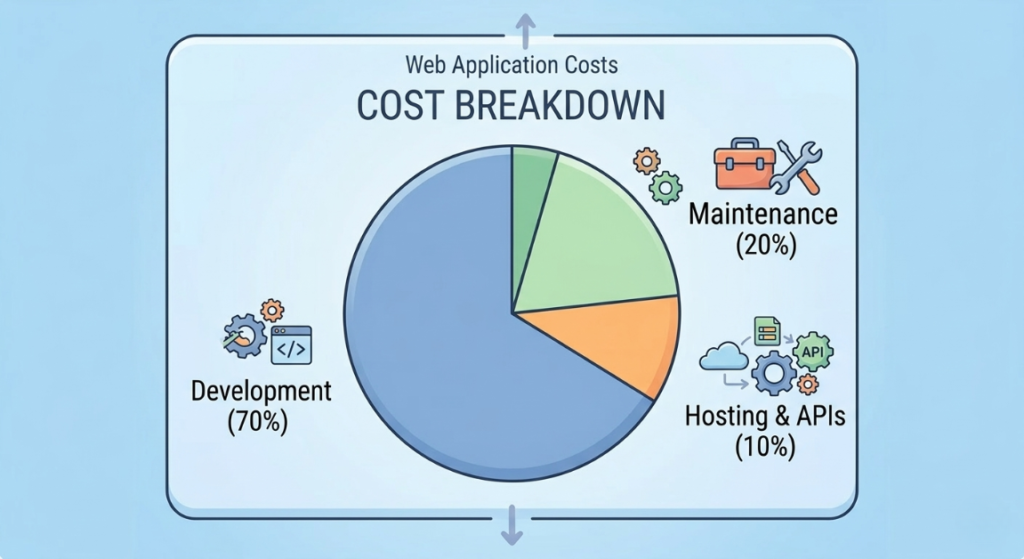
- Hosting: $20 – $200+/month, depending on your traffic.
- Maintenance: A good rule of thumb is to budget 15-20% of the initial development cost per year for maintenance.
- This covers security updates, bug fixes, and minor tweaks. These web app maintenance fees are one of the most common “hidden costs of maintaining a custom web application annually.”
- Third-Party Services: Services like payment gateways (Stripe), email providers (SendGrid), or mapping APIs can have their own monthly fees.
Related Articles You Might Like
If you found this guide on how much it costs to build a simple web app useful, you might also enjoy our deep dive into choosing the right tech stack for your project. We break down even more frameworks and tools to help startups make smart, cost-effective decisions.
How to Validate Your Web App Idea Before Building (2026 Guide)
Frequently Asked Questions
1. How long does it take to build a simple web application?
For a simple web app or MVP, a realistic timeline is between 2 to 4 months. This includes discovery, design, development, and testing. More complex applications can take 6 months or more.
2. What is the best framework for beginners?
For business owners, the “best” framework is one that is popular, well-supported, and gets the job done reliably. Frameworks like Next.js for the frontend and Django for the backend are excellent because they solve many common problems out of the box, which can speed up development.
3. How much does a small business web app cost in 2026?
For a typical small business application (e.g., a booking system, a customer portal), a budget of $15,000 to $50,000 is a realistic starting point when working with a professional team.
A simpler MVP might be closer to the $5,000 – $15,000 range.
4. Should I hire a freelance developer or an agency?
If you have a clear vision, a well-defined scope, and are comfortable managing the project, a freelancer can be a great, cost-effective option. If you need more strategic guidance, design work, and project management, an agency is often a better fit, though more expensive.
5. What is the difference between a website and a web application?
A website is typically static and informational (like a brochure). A web application is interactive. It allows users to perform tasks, manipulate data, and create accounts. Think of the difference between a restaurant’s marketing homepage (a website) and their online ordering system (a web application).
Final Thoughts
Determining how much it costs to build a simple web app is less about finding a magic number and more about understanding the trade-offs. By starting small with an MVP, choosing mainstream technologies, and planning for ongoing costs, you can set your project up for success without breaking the bank.
How to Create a Web App Requirements Document (2026 Guide)
The most important step is to find a development partner you trust someone who will sit down with you over coffee and help you make the right decisions for your business, not just the most expensive ones. Make a smart, informed choice, and you’ll be well on your way to bringing your brilliant idea to life.
Internal Tools vs Off-the-Shelf Software: Build or Buy? (2026)
Call To Action
Have you built a web app for your business? What was your experience with budgeting and costs? Share your story or ask a question in the comments below! We’d love to hear from you. And if you found this article helpful, consider subscribing to our blog for more practical tech advice for small businesses.
Web Application Compliance: GDPR, CCPA, & Accessibility (2026)
Leave a Reply