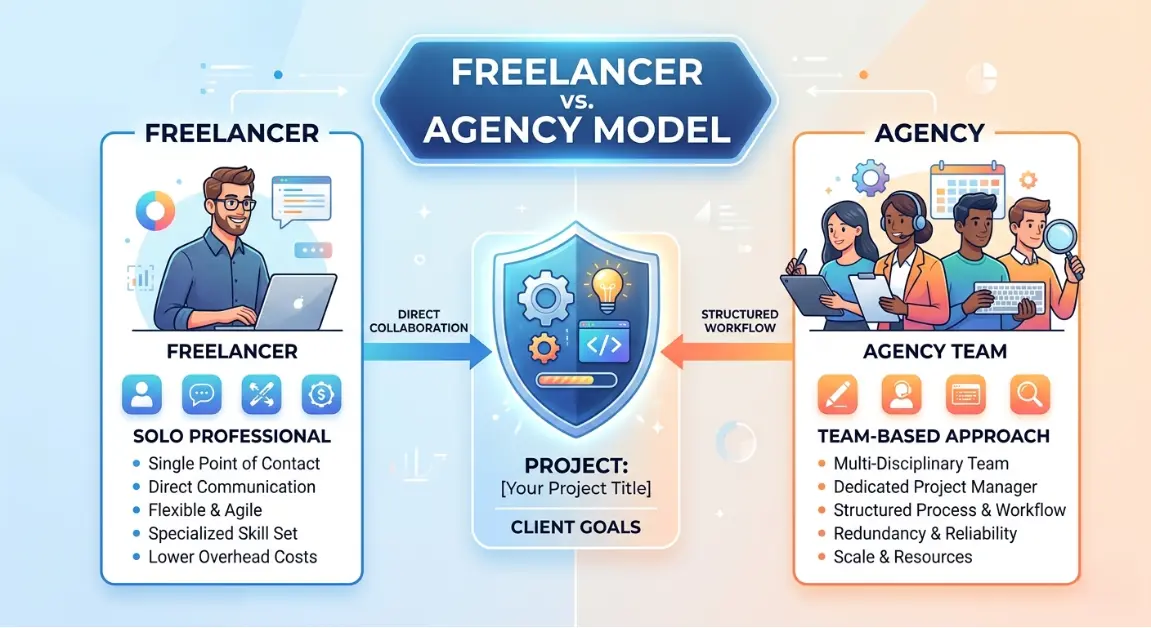
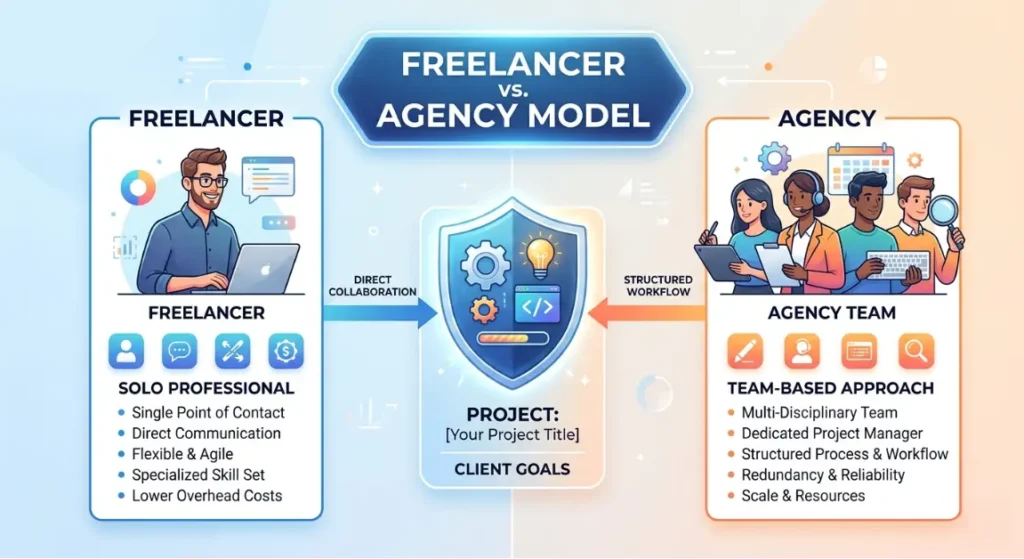
You’ve got a brilliant idea for a web application. You’ve done the research, you know your market, and you’re ready to build. But now you’re facing the first million-dollar question (sometimes literally): who do you hire to bring it to life? This is the classic developer dilemma: Freelance vs Agency: Who Should Build Your Web App?
I’ve sat down for coffee with hundreds of founders, and this question comes up every single time. One person tells you to find a rockstar freelance developer to save money. The next tells you that only a reputable agency can guarantee success. The internet is a sea of conflicting advice, and it’s enough to give anyone analysis paralysis.
My goal with this guide is to clear up the confusion. We’re going to break down the real-world differences, the pros and cons, and the hidden costs. By the end of this, you’ll have a clear framework for deciding on the big question of freelance vs agency: who should build your web app?
Why This Choice Matters for Your Business
Making the right choice in the freelance vs agency debate is about more than just code; it’s about aligning your budget, timeline, and risk tolerance with the right partner. The wrong choice can sink your project before it ever sets sail.
I once worked with a startup that had a complex idea for a fintech platform. They hired a solo freelance developer because the price was right. The freelancer was brilliant, a true coding wizard. But he wasn’t a designer, a security expert, or a project manager. Six months in, they had a powerful but unusable and insecure application. They burned through their budget and had to go back to investors, cap in hand, to pay a web design and development agency to fix the mess.
They didn’t choose a bad developer; they chose the wrong model for their project’s complexity. Understanding the nuances of freelance vs agency: who should build your web app? is a crucial strategic decision.
Understanding the Players: What Are You Really Hiring?
Before we can compare, let’s define our terms. This isn’t just about one person vs. a group of people. It’s about two fundamentally different service models.
- The Freelancer (The Specialist Contractor): A freelancer is a solo expert. Think of them as a highly skilled, specialized general contractor you hire to build your house. They might be a “full-stack” developer who can do a bit of everything, or a specialist who only does frontend or backend work. You work directly with them. They are the talent, the project manager, and the customer support, all in one.
- The Agency (The Full-Service Building Company): An agency is a team of specialists under one roof. When you hire an agency, you’re not just hiring developers. You’re hiring a package that includes a project manager, UI/UX designers, multiple developers (frontend, backend, mobile), quality assurance (QA) testers, and a strategist. They are the full-service building company that handles the architecture, construction, interior design, and plumbing.
This core difference a single expert vs. an integrated team is the key to solving the freelance vs agency: who should build your web app? puzzle.
The 7 Core Factors in the Freelance vs. Agency Decision
This is where we get into the nitty-gritty. How to choose between a freelance developer and a web agency in 2026 comes down to weighing these seven factors against your specific project needs.
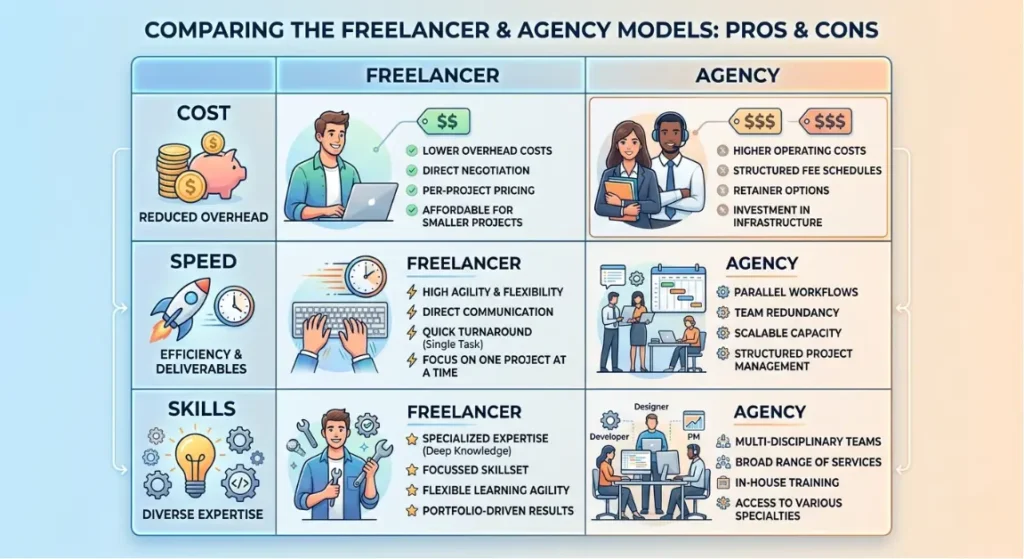
1. Cost & Budget
This is the big one. The cost difference between hiring a freelancer vs agency for web apps is significant.
- Freelancer: You are paying for one person’s time. Costs are lower. Freelance full-stack developer rates in 2026 can range from $50/hour for a junior developer on a global platform to $200+/hour for a senior, US-based specialist. For a simple MVP, you might be looking at $5,000 – $25,000.
- Agency: You are paying for a team, plus the agency’s overhead (office space, management, profit margin). Costs are higher. A project that costs $25,000 with a freelancer could easily be $50,000 – $100,000+ with an agency. They provide detailed quotes that factor into custom website development costs 2026.
Verdict: If your primary constraint is budget, a freelancer is almost always the more affordable option upfront. This makes the freelance vs agency decision seem easy, but cost isn’t everything.
2. Scope & Complexity
- Freelancer: Ideal for smaller, well-defined projects. A Minimum Viable Product (MVP), a marketing website with a simple backend, an internal tool, or adding a feature to an existing app. A single brilliant person can work wonders on a focused task.
- Agency: Shines with complexity. If your project involves multiple platforms (web, iOS, Android), complex integrations, high-security requirements (like HIPAA or finance), or requires significant design and strategy work, an agency’s team of specialists is invaluable.
Verdict: The more moving parts your project has, the more the freelance vs agency scale tips toward an agency.
3. Speed & Timeline
This one is counterintuitive.
- Freelancer: A dedicated, full-time freelancer can often be faster for a simple project. There are no internal meetings or layers of management. It’s a direct line from idea to code.
- Agency: An agency can throw more people at a problem. While a single feature might be slower due to process, they can work on the design, backend, and frontend in parallel, potentially leading to a faster overall timeline for a large, complex project.
Verdict: For a small, focused MVP, a freelancer is often faster. For a large, multi-faceted application, an agency’s parallelism can win out. It’s a key point in the SaaS MVP development comparison.
4. Communication & Project Management
- Freelancer: You have a direct, one-to-one relationship. This can be incredibly efficient. The person making the decisions is the person writing the code. The downside? If they’re not a great communicator, or if you’re not good at managing a project, things can go off the rails.
- Agency: You will almost always have a dedicated Project Manager (PM) or Account Manager. They are your single point of contact. This is great for keeping things organized, but it also adds a layer between you and the developers.
Verdict: If you value a direct line and are comfortable managing the process, a freelancer is great. If you want a more structured, hands-off experience, the freelance vs agency choice points to an agency.
5. Skills & Expertise
- Freelancer: You are hiring a “T-shaped” individual deep expertise in one area (e.g., backend development) and broad skills in others (frontend, databases). It’s rare to find someone who is a world-class expert in design, security, and database architecture.
- Agency: You get access to a team of “I-shaped” experts. You get a dedicated designer for the UI/UX, a dedicated backend developer for the API, and a dedicated frontend developer for the interface. This depth of expertise across multiple domains is an agency’s primary value proposition for web application development services.
Verdict: The freelance vs agency decision here depends on your needs. For an MVP, a T-shaped freelancer is often perfect. For a polished, scalable product, a team of specialists is hard to beat.
6. Flexibility & Agility
- Freelancer: Usually much more flexible. A solo developer can pivot quickly based on your feedback without needing to consult a whole team. They can integrate into your existing workflow or Slack channel seamlessly.
- Agency: Can be more rigid. They often have a set process (e.g., “The Sprint”) that they’ve refined over many projects. This process is designed for predictability and quality, but can sometimes feel slower or less adaptable to sudden changes.
Verdict: If you anticipate your project’s direction changing frequently, the freelance vs agency debate favors the agility of a freelancer.
7. Long-Term Support & Maintenance
- Freelancer: This is the “bus factor.” What happens if your freelancer gets sick, goes on vacation, or gets a great full-time job offer? You can be left scrambling. Good freelancers have contingency plans, but it’s a real risk.
- Agency: An agency has built-in redundancy. If one developer leaves, another can step in. They are structured for long-term support and maintenance contracts because it’s a core part of their business model.
Verdict: For long-term, mission-critical applications, the stability of an agency is a significant advantage in the freelance vs agency calculation.
Red Flags to Watch Out For
Regardless of which path you choose in the freelance vs agency journey, there are sharks in the water. Here are some warning signs.
Freelancer Red Flags: Freelance vs Agency: Who Should Build Your Web App?
- The Overly-Cheap Quote: If a quote seems too good to be true, it is. It often indicates a lack of experience or a misunderstanding of the scope.
- No Portfolio or References: A good freelancer will be proud of their past work and happy to let you speak with previous clients.
- Poor Communication: If they are slow to respond or their messages are unclear during the sales process, it will only get worse once you’ve hired them.
- Can’t Explain Concepts Simply: If they can’t explain their technical plan in a way you understand, they may not understand it well enough themselves.
Agency Red Flags: Freelance vs Agency: Who Should Build Your Web App?
- The Bait-and-Switch: You meet with the senior “A-team” during the sales process, but your project gets handed off to junior developers once you sign. Ask who, specifically, will be working on your project.
- A “Secret” Process: A good web design and development agency will be transparent about their process (Agile, Scrum, etc.). If they can’t explain how they work, run.
- High-Pressure Sales Tactics: If they are pressuring you to sign a contract today, it’s a major red flag. A professional services firm should be consultative, not coercive.
- Lack of a Specialization: An agency that claims to be an expert in everything from mobile games to HIPAA-compliant medical software is likely an expert in nothing.
The Hybrid Approach: The Best of Both Worlds?
The freelance vs agency: who should build your web app? debate doesn’t have to be a binary choice. A popular and effective strategy is the hybrid model:
- Hire a freelance UI/UX designer to create the wireframes and high-fidelity mockups for your app.
- Take those finished designs and hire a freelance developer to build the application.
The Ultimate best frontend framework for beginners 2026 ranking Guide
This approach gives you the specialist design skills of one expert and the focused coding skills of another, often for less than the cost of an agency. It requires more management from you, but it’s a powerful way to control costs while maintaining quality.
Where to Find Your Development Partner
So you’ve weighed the options in the freelance vs agency dilemma and have an idea of what you want. Where do you look?
| Partner Type | Best Platforms & Methods |
| Freelancers | Upwork: Great for project-based work and finding a range of talent.Toptal: A more exclusive (and expensive) network for top-tier freelance talent.Personal Network/Referrals: The absolute best way. Ask other founders who they’ve worked with. |
| Agencies | Clutch.co: A B2B review and rating site, like Yelp for agencies.Google Search: Search for “[Your City] web development agency” or “[Your Industry] app developers.”Industry Conferences & Meetups: A great way to meet local teams in person. |
Finding the right partner is a critical step. Take your time, do your research, and talk to multiple candidates before making a decision on freelance vs agency: who should build your web app?
Cost & Timeline Comparison Table
To make the cost difference between hiring a freelancer vs agency for web apps more concrete, let’s look at a hypothetical MVP project: a simple booking application.
| Partner | Typical Cost | Typical Timeline | Best For… | Rating |
| Freelancer | $10,000 – $30,000 | 2 – 4 months | Founders who are budget-conscious and comfortable with project management. | ⭐⭐⭐⭐⭐ |
| Small Agency | $40,000 – $80,000 | 3 – 5 months | Businesses that need design and development, and want a more hands-off process. | ⭐⭐⭐⭐ |
| Large Agency | $100,000+ | 4 – 6+ months | Enterprise clients or startups with significant funding and complex needs. | ⭐⭐⭐ |
Rating meaning:
- ⭐⭐⭐⭐⭐ = Excellent choice for most small business MVPs.
- ⭐⭐⭐⭐ = A solid, reliable choice if the budget allows.
- ⭐⭐⭐ = Likely overkill for a first version, unless the project is very complex.
Related Articles You Might Like
If you’re still exploring the options in Freelance vs Agency: Who Should Build Your Web App? the freelance vs agency debate, you’ll find our guide on “How to Write a Great Project Brief for Your Web App” incredibly useful. A clear brief is the single best tool for getting an accurate quote from any developer or agency.
Frequently Asked Questions
1. Is it cheaper to hire a freelancer?
Yes, almost always. Freelance full-stack developer rates are lower than an agency’s blended rate because you are not paying for overhead like project managers or office space. However, “cheaper” doesn’t always mean better value. The decision of freelance vs agency should be based on value, not just cost.
2. Can a freelancer handle a large project?
It depends on the freelancer. A highly experienced freelance architect can lead a large project by helping you hire and manage other freelancers. However, if you want a single person to do all the work for a large, complex application, you are likely heading for trouble.
3. What if I hire a freelancer and they disappear?
This is a real risk. To mitigate it, use contracts with clear milestones, pay through platforms that offer escrow (like Upwork), and never pay for large blocks of work upfront. This is a key consideration when deciding freelance vs agency: who should build your web app?
4. Does an agency guarantee my project will be successful?
No. An agency provides a process, a team, and accountability, which significantly increases your chances of success. But a successful web application also requires a good idea, market knowledge, and your own involvement as the business owner. They are a partner, not a magic bullet.
5. How do I choose between a freelance developer and a web agency in 2026?
Start by clearly defining your project scope and budget. If your budget is under $30,000 and your scope is focused (like an MVP), start by talking to top-rated freelancers. If you have a larger budget and need design, strategy, and development, start your search with well-regarded small agencies on Clutch.co.
Final Thoughts
The debate over freelance vs agency: who should build your web app? doesn’t have a single right answer. It has a right answer for you, right now. The best choice depends entirely on your budget, the complexity of your project, your timeline, and how involved you want to be.
How Much Does It Cost to Build a Simple Web App (2026 Guide)
For most first-time founders and small businesses building an MVP, my advice is often to start with a highly-rated, experienced freelancer. The cost savings, speed, and direct communication are invaluable at the early stages. As your business grows and your needs become more complex, Freelance vs Agency: Who Should Build Your Web App? you can always “graduate” to working with an agency.
MVP vs Full Product: What to Build First in 2026
The most important thing is to choose a partner freelancer or agency who you trust, who communicates clearly, Freelance vs Agency: Who Should Build Your Web App? and who is as excited about your business as you are.
Call To Action
What has been your experience? Freelance vs Agency: Who Should Build Your Web App? Did you choose a freelancer or an agency for your project? Share your story, successes, or horror stories in the comments below to help other founders navigate the freel-vs-agency decision. For more practical advice on building your business, subscribe to our newsletter
Best Form Validation Libraries for React 2026 (Business Guide)
Leave a Reply