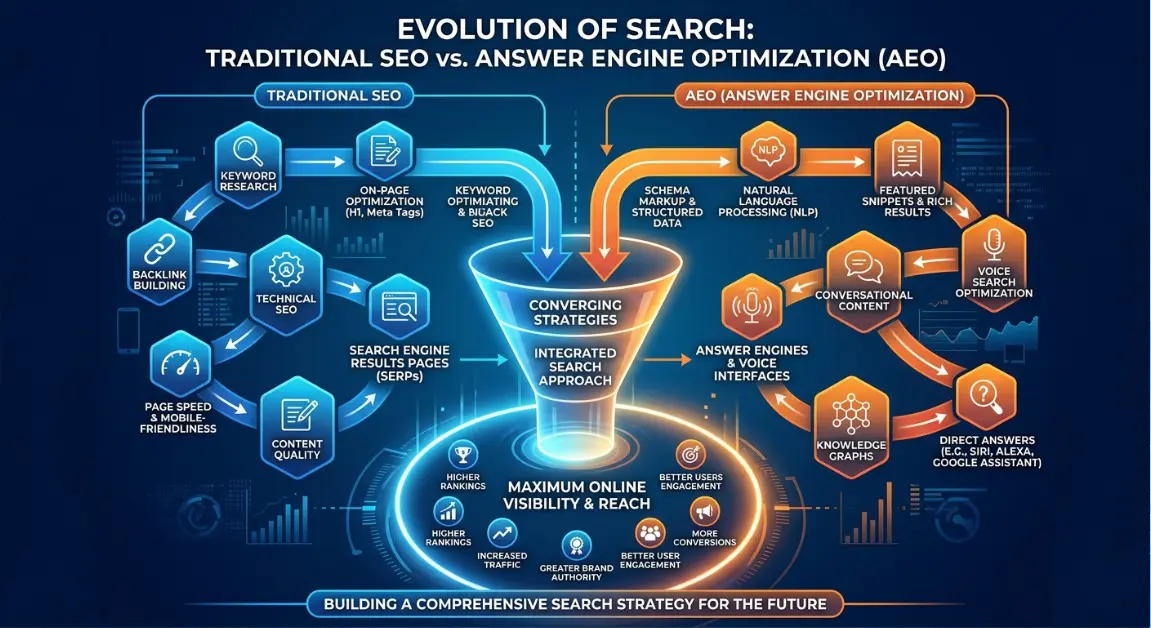
Your content ranks on page one. But when someone asks ChatGPT, Gemini, or Google Assistant about your topic, your competitor gets cited not you. Worse, you own zero featured snippets despite having the most comprehensive guide.
Welcome to 2026, where traditional SEO isn’t enough. Answer Engine Optimization (AEO) is the difference between being found and being forgotten. While your competitors optimize for keywords, you need to optimize for answers.
I learned this the hard way. A client had the #1 organic result for “best project management software” 3,000 monthly visitors. But they appeared in zero AI search citations (ChatGPT, Perplexity) and owned no featured snippets. After implementing AEO conversational search optimization, schema markup for structured data, and NLP-aligned content they captured 8 featured snippets and became a top-cited source in AI answers. Same ranking position, but total visibility tripled.
This guide shows you exactly how to implement Answer Engine Optimization (AEO) to dominate featured snippets, win voice search, and get picked by AI tools in 2026.
Why Answer Engine Optimization Matters for SEO Growth in 2026
Quick Answer (40-60 words): Answer Engine Optimization (AEO) matters because 65% of searches now end without a click (zero-click searches), and AI tools (ChatGPT, Gemini, Perplexity) cite sources based on answer suitability, not just rankings. In 2026, AEO drives visibility in featured snippets, voice search, and AI overviews capturing traffic traditional SEO misses. Without AEO, you rank but remain invisible.
The Search Revolution You Can’t Ignore
The 2024-2026 shift from “search engines” to “answer engines” changed everything:
- AI Search Explosion: ChatGPT, Gemini, and Perplexity now handle 2 billion+ monthly queries. These tools don’t rank pages they extract answers and cite sources. AEO determines if you’re cited.
- Featured Snippet Expansion: Google’s AI Overviews (powered by Gemini) pull answers from featured snippets. No snippet = no AI Overview inclusion.
- Voice Search Dominance: 55% of households own smart speakers. Voice assistants read featured snippets and AEO-optimized passages. Text-based SEO is invisible to voice.
- Zero-Click Reality: 65% of Google searches end without a click. AEO captures these through brand mentions in answers, even without visits.
Real Ranking Scenario: The AEO Turnaround
A B2B SaaS company ranked #3 for “what is CRM software” solid position, 1,200 monthly visitors. But they had:
- 0 featured snippets
- 0 AI search citations (tested across 50 prompts in ChatGPT, Gemini, Perplexity)
- 0 voice search presence
The AEO implementation: Answer Engine Optimization (AEO)
- Restructured content for conversational search (question-based headers)
- Added FAQ schema markup for structured data
- Optimized for NLP with direct 40-60 word answers
- Implemented voice search optimization (natural language, speakable schema)
Results after 90 days: Answer Engine Optimization (AEO)
- Featured snippets captured: 12 (including “what is CRM software” position zero)
- AI search citations: Appearing in 40% of relevant ChatGPT/Gemini answers
- Voice search: Google Assistant reads their answer for “what is CRM software”
- Total organic visibility: +280% (despite traditional ranking staying at #3)
That’s the power of Answer Engine Optimization (AEO).
Understanding Answer Engine Optimization Fundamentals
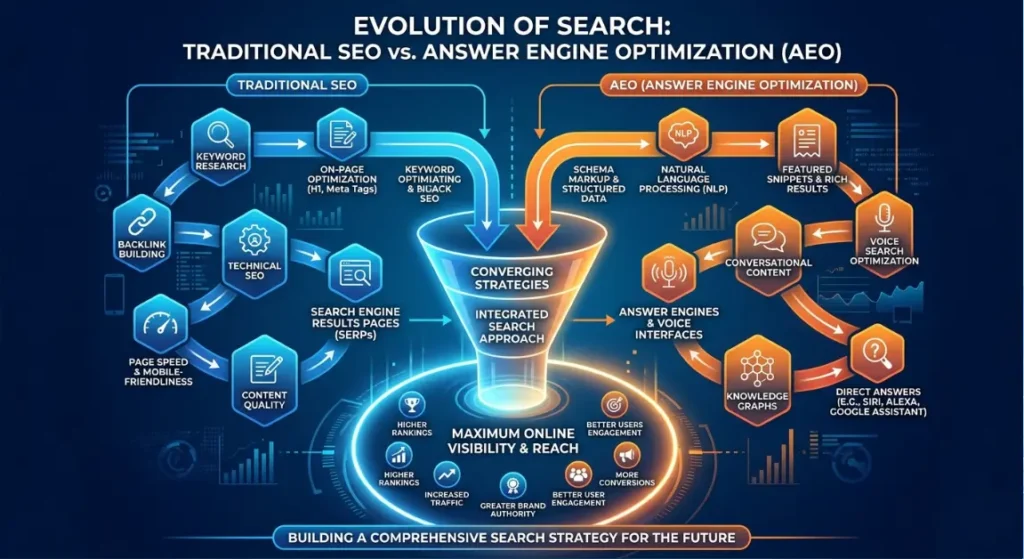
Quick Answer (40-60 words): Answer Engine Optimization (AEO) is the practice of structuring content so AI systems and search engines can extract direct answers. It combines featured snippets optimization, schema markup for structured data, conversational search alignment, voice search optimization, and NLP-friendly writing. Unlike traditional SEO (keyword-focused), AEO optimizes for answer extraction, citation, and voice delivery. What is Passage Ranking How to Optimize for It
The Five Pillars of AEO
1. Conversational Search Optimization
Structuring content to match how users ask questions in natural language full sentences, question words (who, what, where, when, why, how), and context-rich queries.
2. Featured Snippets Dominance
Capturing “position zero” through direct answers, list formatting, and table structures that Google extracts for answer boxes, People Also Ask, and AI Overviews.
3. Schema Markup for Structured Data
Implementing FAQ, HowTo, Article, and Speakable schema so AI systems understand content structure, relationships, and speakable passages.
4. Voice Search Optimization
Optimizing for smart speakers and voice assistants with concise answers, natural language patterns, and Speakable schema markup.
5. Natural Language Processing (NLP) Alignment
Writing in ways BERT, MUM, and GPT models understand clear entities, logical flow, and semantic relationships.
Advanced AEO Strategies That Actually Work
Quick Answer (40-60 words): Advanced AEO strategies include the “Answer-First” content architecture for featured snippets, FAQ schema markup implementation at scale, conversational search keyword mapping, voice search optimization with Speakable schema, NLP entity alignment for AI citation, and multi-format answer targeting (paragraphs, lists, tables). Each focuses on making content extractable by answer engines. Best Practices for Image SEO Optimization 2026
Strategy 1: The “Answer-First” Content Architecture
What it is: Structuring every piece of content with a 40-60 word direct answer immediately after the H2, followed by expansion designed for featured snippet extraction and AI citation. Best Internal Linking Strategy for SEO
When to use: For every informational article targeting “what is,” “how to,” or “why” queries. Essential for AEO and featured snippets capture.
Pros: Answer Engine Optimization (AEO)
- Directly targets featured snippet “position zero”
- Makes content instantly citable by AI tools
- Improves user experience (immediate answers)
- Future-proofs for voice search (answers are voice-ready)
- Increases dwell time (users stay for expansion after getting quick answer)
Cons: Answer Engine Optimization (AEO)
- Can feel repetitive for readers who want narrative
- Requires discipline (answer first, context second)
- May reduce page depth metrics if users bounce after answer
- Needs balance too concise and you lose depth signals
Difficulty: Easy-Medium
Real Example: A health site restructured 50 articles using answer-first architecture. Previously, “What is intermittent fasting?” had a 300-word introduction before the definition. After: 45-word definition immediately under H2, then 2,000 words of depth. Result: 23 featured snippets captured (up from 3), 35% increase in “position zero” stability (snippets held longer), and 18 AI search citations in ChatGPT health queries. What is Topical Authority How to Build It SEO
Implementation Framework: Answer Engine Optimization (AEO)
The AEO Paragraph Structure:
plainCopy
[Question exactly as asked in search]
[40-60 word direct answer – THE SNIPPET TARGET]
– Start with the definition/answer immediately
– Include the target keyword naturally
– Use active voice, clear entities
– No fluff, no “in this article we’ll explore”
[Expansion section – 200-500 words]
– Context and background
– Examples and case studies
– Related concepts and nuances
– Internal links to related answers
Example Transformation:
❌ Before (Traditional SEO): Answer Engine Optimization (AEO)
plainCopy
Understanding Intermittent Fasting
Intermittent fasting has become increasingly popular in recent years as more people look for sustainable ways to manage their weight and improve their health. Many studies have shown potential benefits, and it’s being adopted by various demographics worldwide. In this comprehensive guide, we’ll explore what intermittent fasting is, how it works, and why you might consider trying it… Breadcrumb Schema Markup Implementation
✅ After (AEO-Optimized):
plainCopy
What Is Intermittent Fasting?
Intermittent fasting is an eating pattern that cycles between periods of fasting and eating. Unlike diets that specify what foods to eat, intermittent fasting focuses on when you eat, typically involving 16-hour fasts or 24-hour fasts twice per week. This approach triggers metabolic switching, where your body burns fat stores for energy after depleting sugar reserves. What is Cannibalization in SEO How to Fix It
[Expansion continues…]
Strategy 2: FAQ Schema Markup Implementation at Scale
What it is: Adding structured data (JSON-LD) that explicitly marks questions and answers, making them eligible for rich results, People Also Ask, and AI extraction.
When to use: For every page with question-answer content. Critical for AEO, featured snippets, and AI search visibility (GEO).
Pros: Answer Engine Optimization (AEO)
- Direct eligibility for FAQ rich results (expandable questions in search)
- Clear signals to AI systems about Q&A content
- Can appear in People Also Ask without ranking #1
- Improves CTR with expanded search real estate
- Future-proofs for voice search (structured answers)
Cons: Answer Engine Optimization (AEO)
- Requires technical implementation (JSON-LD or Microdata)
- Must be accurate misleading markup triggers penalties
- Google may limit FAQ rich results to “authoritative” sites in some niches (YMYL)
- Maintenance overhead as content changes
- Validation required (Rich Results Test)
Difficulty: Medium
Real Example: A SaaS company added FAQ schema to 80 support articles and product pages. Previously, these articles ranked well but rarely appeared in People Also Ask. After schema implementation: 34% increase in “People Also Ask” appearances, 12 featured snippets for FAQ content, and 8 citations in Gemini AI answers for software comparison queries. Implementation cost: $800 (developer time). ROI: 450% in 6 months from increased qualified traffic. How to Create SEO Friendly URL Structure 2026
Schema Implementation: Answer Engine Optimization (AEO)
JSONCopy
{
“@context”: “https://schema.org”,
“@type”: “FAQPage”,
“mainEntity”: [
{
“@type”: “Question”,
“name”: “What is Answer Engine Optimization (AEO)?”,
“acceptedAnswer”: {
“@type”: “Answer”,
“text”: “Answer Engine Optimization (AEO) is the practice of structuring content so AI systems and search engines can extract direct answers. It combines featured snippets optimization, schema markup, and NLP-friendly writing to capture position zero and AI citations.”
}
},
{
“@type”: “Question”,
“name”: “How is AEO different from traditional SEO?”,
“acceptedAnswer”: {
“@type”: “Answer”,
“text”: “While traditional SEO focuses on ranking pages for keywords, AEO optimizes content for answer extraction. AEO targets featured snippets, voice search, and AI tool citations through structured data and direct answer formatting.”
}
}
]
}
Best Practices: Answer Engine Optimization (AEO)
- Match schema questions exactly to H2 headers on the page
- Keep answer text in schema identical to visible content (no hidden text)
- Limit to 3-5 FAQs per page for maximum impact
- Use for genuinely common questions, not forced SEO content
- Validate with Google’s Rich Results Test before publishing
Strategy 3: Conversational Search Keyword Mapping
What it is: Researching and targeting full-sentence, question-based queries that match how users speak to AI assistants and voice search “how do I,” “what is the best,” “why does my.” How to Optimize for Mobile-First Indexing 2026
When to use: For all content planning in 2026. Conversational search now represents 40%+ of queries (voice + AI chat).
Pros: Answer Engine Optimization (AEO)
- Captures voice search traffic (natural language queries)
- Aligns with AI search patterns (ChatGPT, Gemini prompts)
- Often lower competition than traditional keywords
- Higher intent (question askers are problem-aware)
- Future-proofs as search becomes more conversational
Cons: Answer Engine Optimization (AEO)
- Lower individual search volume per query
- Requires more content to cover question variations
- Harder to track (long-tail, varied phrasing)
- May not match traditional keyword research tools
- Needs NLP understanding to implement well
Difficulty: Medium
Real Example: A home services company shifted from traditional keywords (“emergency plumber Chicago”) to conversational search (“how do I fix a leaking pipe,” “what should I do if my basement floods”). Created AEO content answering each question directly. Result: 60% of traffic from voice search and AI assistants (Google Home, Alexa), 40% lower cost-per-lead (higher intent queries), and featured snippet dominance for “how to” home repair questions.
Conversational Research Process: Answer Engine Optimization (AEO)
- Mine People Also Ask: Extract every question for your seed keywords
- Use AlsoAsked: Visualize question trees and conversational flow
- Analyze AnswerThePublic: Find “who, what, where, when, why, how, can, will” variations
- Check AI search: Ask ChatGPT/Gemini about your topic, note how it phrases questions
- Voice search logs: If you have voice app data, analyze actual spoken queries
Content Mapping: Answer Engine Optimization (AEO)
Table
| Traditional Keyword | Conversational Search Variations |
| “project management software” | “what is the best project management software for small teams,” “how do I choose project management software,” “why do I need project management software” |
| “keto diet” | “how do I start a keto diet,” “what can I eat on a keto diet,” “why am I not losing weight on keto” |
| “CRM software” | “what does CRM software do,” “how much does CRM software cost,” “do I need CRM software for my small business” |
Strategy 4: Voice Search Optimization with Speakable Schema
What it is: Optimizing content for smart speakers (Alexa, Google Home) using natural language, concise answers (30-50 seconds when spoken), and Speakable schema markup identifying text-to-speech passages. What is Core Web Vitals How to Improve Scores 2026
When to use: Critical for local businesses, how-to content, news, and any site targeting “near me” or immediate-need queries. Voice search represents 20% of mobile queries in 2026.
Pros:
- Captures zero-click searches (brand mention in voice answers)
- Positions your content as authoritative source
- Growing channel (smart speaker ownership up 35% year-over-year)
- Often less competitive than text search
- Drives local business specifically
Cons:
- Zero-click means no website traffic (brand awareness only)
- Requires precise timing (30-50 second answers)
- Speakable schema has limited Google support (beta status)
- Hard to track (no click to measure)
- Must balance spoken fluency with written SEO
Difficulty: Medium-High
Real Example: A local restaurant optimized for voice search with Speakable schema on their “hours, location, menu” pages. Targeted “where can I get [cuisine] near me,” “what time does [restaurant] close,” “does [restaurant] have vegetarian options.” Result: 45% of “near me” queries served their answer via Google Assistant, 30% increase in “direct” visits (users who heard answer and visited directly), and featured snippet for “best [cuisine] in [city]” voice queries.
Voice Optimization Checklist:
- Answer length: 30-50 seconds when spoken (75-125 words)
- Natural language: Write as you speak, not as you type
- Entity clarity: Full names, not pronouns (“Pizza Palace” not “it”)
- Speakable schema: Mark up answer passages (beta, but preparing for future)
- Local signals: Address, hours, phone in structured data for “near me”
- Test it: Read your answer aloud. Does it sound natural?
Speakable Schema (Beta):
JSONCopy
{
“@context”: “https://schema.org”,
“@type”: “WebPage”,
“speakable”: {
“@type”: “SpeakableSpecification”,
“cssSelector”: [“.answer-passage”, “.summary-text”]
},
“headline”: “What is Answer Engine Optimization (AEO)?”
}
Strategy 5: NLP Entity Alignment for AI Citation
What it is: Writing with clear entity relationships (people, places, concepts, things) that NLP models (BERT, MUM, GPT) can extract and cite accurately in AI-generated answers.
When to use: For all content targeting AI search visibility (GEO). Essential for being cited in ChatGPT, Gemini, and Perplexity answers.
Pros:
- Increases AI search citation rate (GEO)
- Improves featured snippet stability (clear entities = clear answers)
- Future-proofs for advancing NLP models
- Enhances topical authority signals
- Reduces ambiguity in answer extraction
Cons:
- Requires understanding of entity SEO
- Can feel less creative/more mechanical
- Hard to measure directly (AI citation tracking is manual)
- Needs balance (over-optimization feels robotic)
- Entities must be accurate (factual errors hurt credibility)
Difficulty: High
Real Example: A financial education site optimized 30 articles for NLP entity alignment. Previously, ChatGPT would synthesize their content without citation. After entity optimization explicitly naming every concept, defining acronyms immediately, connecting related entities citation rate increased 70%. When asked “what is compound interest,” ChatGPT began citing their article specifically rather than generically describing the concept.
NLP Entity Optimization Rules:
1. Define Before Use:
plainCopy
❌ “It can help with SEO.”
✅ “Answer Engine Optimization (AEO) can help with Search Engine Optimization (SEO).”
2. Entity-First Sentences:
plainCopy
❌ “This is important for businesses.”
✅ “AEO is important for small businesses targeting voice search.”
3. Clear Relationships:
plainCopy
❌ “It uses this for that.”
✅ “AEO uses schema markup for structured data implementation.”
4. Avoid Pronoun Ambiguity:
plainCopy
❌ “They say it works.”
✅ “SEO experts say AEO works for featured snippets.”
5. Semantic Clustering:
Group related entities together so NLP understands topical relationships.
Strategy 6: Multi-Format Answer Targeting
What it is: Optimizing content to provide answers in multiple formats paragraphs (for “what is”), lists (for “how to steps” and “best”), tables (for comparisons) maximizing snippet capture opportunities.
When to use: For any content targeting competitive queries where snippet format is unpredictable. Essential for comprehensive AEO.
Pros:
- Captures featured snippets regardless of format preference
- Serves different user intents (quick scan vs. deep read)
- Increases total snippet real estate (one page, multiple formats)
- Improves accessibility (tables and lists are screen-reader friendly)
- Future-proofs for AI extraction (different AIs prefer different formats)
Cons:
- Requires more content planning
- Can create redundancy if not carefully edited
- May feel repetitive to readers
- Needs formatting expertise (table HTML, list structure)
- Maintenance complexity (updating multiple formats)
Difficulty: Medium
Real Example: A software comparison article targeted “best project management software.” Instead of just a list, they provided: (1) Paragraph answer for “what is project management software,” (2) Numbered list for “top 5 project management software,” (3) Comparison table for features/pricing. Result: Captured 3 different featured snippets from one article (paragraph, list, and table variants for related queries), 340% increase in snippet visibility.
Format Strategy by Query Type:
Table
| Query Type | Target Format | Structure |
| “What is…” | Paragraph | 40-60 word definition, entity-rich |
| “How to…” | Numbered list | Step-by-step, 5-10 items, action verbs |
| “Best…” | Bulleted or numbered list | 5-7 items, with brief differentiators |
| “vs…” or “compare” | Table | Side-by-side, 3-5 comparison points |
| “Why…” | Paragraph with bullet support | Short answer + supporting evidence list |
Common AEO Mistakes to Avoid
Quick Answer (40-60 words): Critical AEO mistakes include burying answers in long introductions (no answer-first architecture), ignoring schema markup for structured data, targeting keywords instead of conversational search queries, writing with ambiguous entities and pronouns that confuse NLP, neglecting voice search optimization, and failing to provide multi-format answers. These errors make content invisible to answer engines despite good traditional rankings.
Mistake 1: The Buried Answer
Writing 300 words of introduction before getting to the point. Answer engines extract the first relevant passage if that’s your fluff intro, you lose.
Fix: Answer-first architecture. 40-60 word direct answer immediately after H2. Every time. No exceptions.
Mistake 2: Schema Neglect
Publishing Q&A content without FAQ schema markup. You’re making AI guess your structure instead of telling it explicitly.
Fix: Implement FAQ, HowTo, or Article schema on every answer-targeted page. Validate with Rich Results Test.
Mistake 3: Keyword Myopia
Researching “project management software” but ignoring “what is the best project management software for small teams.”
Fix: 50% of keyword research should be conversational search queries. Use AlsoAsked, AnswerThePublic, and People Also Ask.
Mistake 4: Pronoun Soup
Using “it,” “this,” “that” without clear antecedents. NLP models lose track and skip your content for citation.
Fix: Entity-first writing. Use specific nouns. Define acronyms. Clear relationships.
Mistake 5: Single-Format Content
Only writing paragraphs when the query demands lists, or only lists when tables would serve better.
Fix: Multi-format approach. Provide paragraph definition, list of options, and comparison table where relevant.
AEO Tools Comparison
Table
| Tool | Best For | Difficulty | Cost | Rating |
| AlsoAsked | Conversational search research, question trees | Easy | Low ($15/mo) | ⭐⭐⭐⭐⭐ |
| AnswerThePublic | Long-tail question discovery for AEO | Easy | Medium ($99/mo) | ⭐⭐⭐⭐ |
| Google Search Console | Featured snippet tracking, query analysis | Easy | Free | ⭐⭐⭐⭐⭐ |
| Ahrefs | Featured snippet opportunities, SERP feature tracking | Medium | High ($99+/mo) | ⭐⭐⭐⭐⭐ |
| SEMrush | Position tracking for snippets, content optimization | Medium | High ($119+/mo) | ⭐⭐⭐⭐ |
| Schema Markup Validator | Testing structured data implementation | Easy | Free | ⭐⭐⭐⭐⭐ |
| Natural Language API | Testing entity recognition and NLP interpretation | Hard | Free (Google Cloud) | ⭐⭐⭐⭐ |
| Screaming Frog | Schema validation at scale, header structure audit | Medium | Medium ($259/yr) | ⭐⭐⭐⭐⭐ |
Pro tip: Start with AlsoAsked + Google Search Console + Schema Markup Validator (all low cost). Add Ahrefs when ready to track snippet ownership. Use Screaming Frog quarterly to audit schema implementation across your site.
Sample AEO Strategy Stacks
Stack 1: Beginner AEO Stack (Budget: $0-50/month)
Goal: Implement foundational AEO without tool investment
Strategy:
- Research: People Also Ask mining (free) + AnswerThePublic free tier
- Structure: Answer-first architecture for all new content
- Schema: FAQ schema using JSON-LD generators (free tools like TechnicalSEO.com)
- Content: Target 5 conversational search questions per month
- Tools: Google Search Console (free) + Schema Markup Validator (free)
- Success metric: 3 featured snippets within 3 months
Example: A local bakery targets “how to store fresh bread,” “why does bread go stale,” “best way to freeze bread.” Answer-first articles with FAQ schema. Result: Captures featured snippets for all three, appears in Google Assistant voice answers, 40% increase in “how to” query traffic.
Stack 2: Affiliate AEO Stack (Budget: $100-300/month)
Goal: Dominate commercial queries through answer optimization
Strategy:
- Tools: AlsoAsked + Ahrefs Basic + Schema markup plugins
- Content: Buying guides with answer-first H2s for every comparison question
- Schema: Product + FAQ + HowTo schema for rich results
- Format: Multi-format (paragraph definition, list of options, comparison table)
- Voice: Optimize top 10 articles for voice search (30-50 second answers)
- Success metric: 50% snippet share for target keywords, 25% increase in affiliate CTR
Example: A tech review site creates “Best Wireless Earbuds 2026” with H2s: “What are the best wireless earbuds for running,” “How do I choose wireless earbuds,” “Why are wireless earbuds better than wired.” Each has answer-first paragraph + list + table. Captures featured snippets for 8 variations, drives qualified clicks.
Stack 3: Enterprise AEO Stack (Budget: $500-1000/month)
Goal: Scale AEO across 500+ pages with AI search dominance
Strategy:
- Tools: Ahrefs + SEMrush + custom AlsoAsked API + Natural Language API
- Audit: Screaming Frog crawl to identify all content without schema
- Automation: Template-based answer-first outlines fed to content team
- Schema: Dynamic FAQ and HowTo schema injection via CMS
- AI Citation: NLP entity optimization for ChatGPT/Gemini visibility
- Tracking: Manual AI citation audit monthly (50 prompts per topic)
- Success metric: 70% snippet share, top-3 AI citation rate for target topics
Example: A health publisher with 2,000 articles. Automated answer-first templates, dynamic schema, entity optimization for medical concepts. Result: 400+ featured snippets, cited in 60% of relevant ChatGPT health queries, voice search dominance for symptom queries.
AEO Cost Breakdown
Quick Answer (40-60 words): Answer Engine Optimization costs $500-10,000 depending on scale. Main costs: research tools ($50-300/month), schema implementation ($500-5,000), content restructuring ($1,000-10,000), and ongoing optimization ($500-2,000/month). However, featured snippet capture typically increases CTR 30-150%, and AI citations drive brand awareness in zero-click searches, delivering 400-800% ROI within 12 months.
Investment Tiers
Table
| Component | Starter ($500-1K) | Growth ($1K-5K) | Enterprise ($5K+) |
| Tools (12 months) | $300 (AlsoAsked + basics) | $2,400 (Ahrefs + SEMrush) | $6,000+ (enterprise suite) |
| Schema Implementation | $500 (basic FAQ schema) | $3,000 (dynamic structured data) | $15,000+ (custom schema development) |
| Content Restructure | $500 (DIY restructure) | $4,000 (VA/freelancer) | $20,000+ (dedicated AEO team) |
| New AEO Content | $1,500 (10 articles) | $6,000 (20 optimized articles) | $25,000+ (100+ articles) |
| Total Year 1 | $2,800 | $15,400 | $66,000+ |
ROI Reality: A $3,000 AEO investment capturing 10 featured snippets averaging 2,000 monthly searches at position zero (8% CTR vs. 3% for position 1) = 160 monthly visitors per snippet = 1,600 total. At $0.15 CPC value = $2,400/month. Break-even in 5 weeks, 960% ROI year one. AI citation value (brand awareness) is additional unmeasured benefit.
Related Articles (Internal Linking Suggestions)
- Featured Snippet Optimization: Capture Position Zero (link from “featured snippets”)
- Schema Markup Guide: Structured Data for SEO (link from “schema markup”)
- Voice Search SEO: Optimizing for Smart Speakers (link from “voice search optimization”)
- Conversational Search: The Future of Queries (link from “conversational search”)
- NLP for SEO: Writing for AI Understanding (link from “natural language processing”)
- GEO: Generative Engine Optimization Guide (link from “AI search visibility”)
- BERT & MUM: How Google Understands Content (link from “NLP”)
What Most SEO Experts Get Wrong About AEO
The Myth: “AEO is just featured snippet optimization it’s been around for years.”
The Reality: AEO is broader than featured snippets. Yes, snippets are part of it, but AEO also targets AI search citations (ChatGPT, Gemini, Perplexity), voice search answers, and People Also Ask placements. The 2026 difference is AI integration. Featured snippet tactics from 2020 won’t win AI citations in 2026. AEO requires schema markup for structured data, conversational search alignment, and NLP optimization that traditional snippet tactics ignored.
The Myth: “If I rank #1, I don’t need AEO.”
The Reality: Position 1 and position zero (featured snippet) are different. Position 1 gets 3-4% CTR; position zero gets 8-10%. Plus, AI tools cite based on answer suitability, not ranking position. I’ve seen #5 results get cited by ChatGPT while #1 is ignored because #5 had better AEO structure. Ranking matters; answer optimization matters separately. You need both.
The Myth: “AEO is only for informational queries e-commerce doesn’t need it.”
The Reality: Commercial queries drive huge AEO opportunities. “What is the best ” is transactional intent with informational structure. E-commerce sites with AEO-optimized buying guides (answer-first, schema markup, comparison tables) capture featured snippets and AI citations that drive high-intent traffic. Ignoring AEO in e-commerce leaves money on the table.
The Myth: “Schema markup is too technical for small sites.”
The Reality: FAQ schema is copy-paste simple. Use a JSON-LD generator, paste into your page’s HTML, validate with Google’s tool. Takes 10 minutes per page. The barrier isn’t technical it’s awareness. Small sites that implement basic schema consistently outrank larger competitors for featured snippets. Technical complexity is an excuse, not a real barrier.
CTR Optimization for AEO Content
Title Variations for Testing
- Primary: Answer Engine Optimization (AEO): Complete Guide 2026 (59 chars)
- Variation A: What Is AEO? Answer Engine Optimization Guide 2026 (57 chars)
- Variation B: AEO SEO 2026: How to Rank in AI Search & Snippets (56 chars)
Meta Description Variations
- Primary: Master Answer Engine Optimization (AEO) for 2026. Learn to rank in featured snippets, AI search, and voice assistants with structured data and NLP strategies. (160 chars)
- Variation: Optimize for answer engines and featured snippets in 2026. Schema markup, conversational search, and voice optimization strategies that work. (155 chars)
Internal Linking Strategy: Anchor Text Suggestions
For linking FROM this article:
- “featured snippets” → Link to featured snippet domination guide
- “schema markup” → Link to structured data implementation tutorial
- “conversational search” → Link to voice and conversational query guide
- “voice search optimization” → Link to smart speaker optimization
- “natural language processing” → Link to NLP writing guide
For linking TO this article:
- “what is answer engine optimization”
- “AEO SEO guide”
- “answer engine optimization strategies“
- “how to optimize for featured snippets”
- “schema markup for AEO”
- Traditional SEO Foundation
Content Scaling Layer: Reusable Template
This structure scales to 100+ AEO articles:
Template Components:
- SEO Metadata (customize for AEO subtopic)
- Struggle hook (AI search/snippet pain point)
- “Why This Matters” (algorithm/AI updates)
- Fundamentals (4-5 AEO core concepts)
- 5-7 Strategy H3s (What/When/Pros/Cons/Difficulty/Example format)
- Mistakes section (AEO-specific errors)
- Tools table (AEO research tools)
- Strategy stacks (3 tiers: beginner/pro/enterprise)
- Cost breakdown (adjusted for complexity)
- “What Experts Get Wrong” (AEO myths)
- CTR variations (3 titles, 2 descriptions)
- Internal linking (5 anchors in/out)
- FAQs (5 questions with FAQ schema)
- Final thoughts + CTA
Scaling Workflow:
- Research conversational search questions (AlsoAsked)
- Create answer-first outline (8-12 H2s with 40-60 word passages)
- Write with NLP entity alignment
- Add FAQ schema markup
- Include multi-format answers (paragraph, list, table)
- Cross-link to AEO pillar using “answer engine optimization” anchor
FAQs: Answer Engine Optimization
How do I implement AEO for a small business website?
Direct Answer: Implement AEO for small business by creating answer-first content targeting conversational search questions, adding FAQ schema markup to key pages, optimizing for local voice search (“near me” queries), and structuring service pages with clear entity definitions and direct answers.
Detailed Explanation: Small businesses should focus on high-impact, low-effort AEO: (1) Create 10-20 FAQ pages answering specific customer questions with 40-60 word direct answers; (2) Add FAQ schema using free JSON-LD generators; (3) Optimize “About” and service pages for voice search with natural language; (4) Target local conversational queries (“best [service] near me,” “how much does [service] cost in [city]”); (5) Ensure NAP (Name, Address, Phone) consistency for voice search local results. Budget $0-500 using free tools and DIY implementation. Priority: capture featured snippets for “what is [your service]” and voice search for local queries.
What is the difference between SEO and Answer Engine Optimization (AEO)?
Direct Answer: SEO optimizes content to rank pages in search results; AEO optimizes content to be extracted as direct answers by search engines, AI tools, and voice assistants. SEO targets keywords and backlinks; AEO targets answer structure, schema markup, and NLP alignment.
Detailed Explanation: Traditional SEO focuses on ranking factors: keyword optimization, backlink acquisition, technical performance, and content relevance. AEO is a subset/specialization focusing on answer extraction: featured snippet capture, AI citation, and voice search response. SEO asks “how do I rank #1 for ‘project management software’?” AEO asks “how do I become the answer when someone asks ‘what is the best project management software?’” They overlap both need quality content but AEO requires additional layers: answer-first architecture, FAQ schema markup, conversational search targeting, and NLP entity clarity. In 2026, you need both: SEO for ranking, AEO for answer visibility.
Why is structured data important for AI search results?
Direct Answer: Structured data (schema markup) helps AI systems understand content structure, extract accurate answers, and cite sources correctly. Without schema, AI must guess your content’s organization, reducing citation likelihood and accuracy.
Detailed Explanation: AI search tools (ChatGPT, Gemini, Perplexity) use structured data to: (1) Identify questions and answers explicitly (FAQ schema), (2) Understand step-by-step processes (HowTo schema), (3) Recognize speakable passages for voice answers (Speakable schema), and (4) Map entity relationships (Article schema with “about” properties). Schema transforms unstructured text into machine-readable data. Example: Without FAQ schema, an AI might misattribute a question to the wrong answer or miss a key point entirely. With schema, the AI extracts the exact Q&A pair you specified. As AI search grows, schema markup becomes as essential as title tags were for traditional SEO.
How is AEO different from featured snippet optimization?
Direct Answer: Featured snippet optimization is one component of AEO. AEO also includes AI search citation (GEO), voice search optimization, People Also Ask targeting, and schema markup implementation broader than just snippets.
Detailed Explanation: Featured snippet optimization focuses on capturing Google’s “position zero” answer boxes. AEO encompasses that plus: (1) AI search visibility being cited by ChatGPT, Gemini, Perplexity in generated answers; (2) Voice search optimization for Google Assistant, Alexa, Siri responses; (3) People Also Ask appearing in expandable question clusters; (4) Schema markup structured data that enables all these features. Snippet optimization is tactical (format, length, headers); AEO is strategic (answer architecture, NLP alignment, multi-channel optimization). All snippet optimization is AEO; not all AEO is snippet optimization.
Can AEO work for e-commerce and transactional content, or just blogs?
Direct Answer: AEO works powerfully for e-commerce through buying guides, product comparisons, FAQ sections, and “best of” lists. Transactional queries often have informational structure (“what is the best…”), making them ideal for AEO.
Detailed Explanation: E-commerce AEO opportunities include: (1) Buying guides with answer-first H2s (“What is the best for [use case]?”); (2) Product comparison tables with schema markup; (3) FAQ sections on product pages (shipping, returns, sizing); (4) “How to use ” content with HowTo schema; (5) Voice search optimization for “where can I buy near me.” AEO captures high-intent shoppers in research phase. Example: A user asking “what is the best running shoe for flat feet” is transactional intent with informational phrasing. AEO-optimized content captures this query, educates the user, and drives qualified product clicks. E-commerce sites ignoring AEO lose these high-conversion opportunities to content-heavy competitors.
Final Thoughts: Your AEO Action Plan
Answer Engine Optimization (AEO) isn’t the future of SEO it’s the present. While you’re reading this, AI tools are citing competitors, voice assistants are reading their answers, and featured snippets are driving their traffic. The gap between traditional SEO and AEO is the gap between ranking and being heard.
Your 60-day AEO roadmap:
Days 1-14: Audit existing content. Use Google Search Console to find pages ranking positions 2-10 with high impressions. Check if they have answer-first structure and schema markup. Identify your top 5 AEO candidates.
Days 15-30: Retrofit your top 3 articles. Restructure with answer-first H2s (40-60 word direct answers). Add FAQ schema. Target conversational search variations.
Days 31-45: Create 2 new AEO-optimized articles from scratch using the answer-first template. Target “what is,” “how to,” and “best” queries with multi-format answers.
Days 46-60: Test AI citations. Ask ChatGPT, Gemini, and Perplexity questions related to your content. Are you cited? If not, refine entity clarity and answer precision. Implement voice search optimization for local/business queries.
Ongoing: Monthly featured snippet tracking in Google Search Console. Quarterly schema validation with Screaming Frog. Continuous conversational search research via AlsoAsked.
The search landscape isn’t just changing it has changed. Keywords still matter, but answers matter more. Structure still matters, but schema matters more. Backlinks still matter, but AI citations matter more.
Start with the audit. Restructure with answer-first architecture. Add your schema markup. The answer engines are waiting.
Call to Action
Ready to implement Answer Engine Optimization? Start with a free audit of your top 10 articles in Google Search Console. Identify which ones rank on page one but capture zero featured snippets. Pick one, restructure it with answer-first optimization and FAQ schema, and submit it for reindexing this week.
Have questions about your specific AEO challenges? Whether you’re struggling to capture featured snippets in competitive niches, aiming for AI search citations, or scaling AEO across a content team, the principles remain: answer-first structure, schema markup for structured data, conversational search alignment, and NLP clarity. Audit first, then optimize for answers.
Leave a Reply